
Cleanroom

Teenage clutter is one of the common threads in the Zits comic strip.
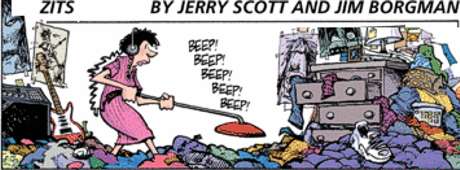
http://www.chron.com/apps/comics/showComick.mpl?date=20101114&name=Zits
I have raised two (now-thankfully-former) teenagers, so I relate to the clutter but I don’t remember my own teenaged years quite the same way.

See, back in the days that marked my own adolescence, when we walked three miles through the waist deep snow to school, uphill each way, we didn’t have that much stuff.

My parents spent their teen years in the Great Depression and it defined them — and me — in many ways. I have reused and repaired and recycled if I couldn’t reuse or repair far longer than Kermit the (green) Frog. I hate to throw anything away that might be somehow handy later. And I don’t buy materiel without due … consideration. As a kid, they (and later I) wanted for little. We eventually had a teevee. We had an end room full of books. We had a boat. We had a garden and two cars. We ate and dressed as well as anyone else I knew. I still wear khaki slacks and blue cotton button down oxford shirts, of course. I didn’t get a used dog until I was nearly 50; nothing but new dogs before that. And I gave away our only used cat.

But we didn’t have a lot of stuff.

Oh, sure, we had washing machine and a dryer in the kitchen because that’s where my mom wanted them. And two vacuum cleaners, one for upstairs and one for downstairs.

It surprised me to learn that the U.S. had a small boom in middle-class home ownership before World War II. The post-war boom apparently built on that, and on the pent-up demand from the Depression. The war stopped the fledgling consumerism and it took several years for the factories to gear back up, years that many returning G.I.s spent in college. Consumers started finding stuff to buy again in the 1950s. My folks bought an brand new 1950 Ford convertible. The television didn’t come until 1955. Got the “little boat,” a 21-foot cabin cruiser, in 1957.

But we didn’t have a lot of stuff.

Oh, sure, I had a Rawlings glove but it lived in the “toy box” on the back porch. There was no plethora of cleats and Air Jordans and walking shoes and running shoes and everyday sneaks and splashing-around-getting-mucky sneaks and sandals and Crocs. I had a pair of Keds. In the closet.

We had two phones in the house. I never had one in my room.

The 80s brought us the boombox. I truly have never owned one although I did borrow my dad’s transistor radio to carry to school in fifth grade.

Motorola sold the first cellphone in 1984. I didn’t have one. Or a computer, or a smart phone, or a TV in my room

We didn’t have a lot of stuff mostly because there wasn’t nearly as much stuff to have.

In Zits, mom Connie Duncan needs a metal detector to find her car keys in son Jeremy’s room. Maybe the Duncans “gotta move, gotta get a bigger house. Why? No room for [their] stuff anymore.

I didn’t need to move until much later in life. Back then, I didn’t store my clothes on the floor.


Premte Peeves

Retailers created 151,000 new jobs in October, nearly triple the number for the Octobers of 2009 and 2008, according to John Challenger and Barack Obama. Talking heads from the White House to WKRP have lauded this as the turn around we’ve waited for.

Let’s see what the prez to the pundits didn’t tell us:
(a) The number of US workers who filed new claims for unemployment benefits fell 24,000 last week to 446,500. That’s a net loss <mumble><mumble> carry-the-two of 295,500 jobs.
(b) The people losing those $50,000 jobs are engineers and teachers and not $17,000 Wally World clerks.
(c) Seasonal jobs like these always post gains during the holidays. Guess what happens after the holidays?
(d) Most surprising of all, population growth means we need 100,000 jobs just to stay even so October’s net loss wasn’t almost 300,000 jobs. It was nearly 400,000 jobs.

So what’s the peeve? Other than the fact that my friend and my wife are both still unemployed, everyone from the prez to the pundits have pulled the wool over your eyes. Again.


Did You (Can You) Pass Math?

Did You Pass Math? is a blogware plug-in that “restricts comment spam by throwing the commenter a simple math question.” It works about 100% of the time against automated coments. Unfortunately, it also works about 50% of the time against real coments. When it fails, it eats your comment. I think it fails most often around suppertime.

Here’s the scoop. Either include a nice, Dunning-sized scoop of rum raisin ice cream with your comment or write your comment in a separate app like Notepad or your word processor of choice, then copy and paste it into the comment field.

Thanks!


Getting It Up Early

I have a houseful of visitors here in the Keys. I don’t understand that. In our more than 30 years in Vermont, we can count our out-of-state visitors on our fingers. Here in Paradise, visitors are numbered like grains of sand. Anyway, our friend Missy noticed that I was “up bloody early” today (Biff was still snoring then).

“No,” I told Missy. “It is the clock that has changed. I’m up at the exact same [solar] time I get up every morning.”

Thanks to the visitors, I was actually late-ish getting to bed last night and therefore late-ish getting to sleep. Late-ish is defined as early-ish by Daylight Savings standards but later in terms of the hour at which I planned to arise. The alarm makes sure I rise correctly no matter how long the temptations of the night before seduce me.

Farmers have lived according to the sun for as long as there has been fixed base agriculture. Although my great-grandfather was a dairy farmer — I grew up on the last few acres of his farm, then made a home on the last few acres of a former Vermont dairy farm — I do not farm. I prefer sleeping in and generally like to roll out of bed about 30 seconds before I have to go to work. It also means I can see the sunset, the moonrise, and the clocks strike midnight.

Clock setting is arbitrary, all because somebody in “the dawn of time” jammed a stick in the ground and decided that getting his farm workers up at 4 ayem was a good idea. Some of us don’t agree. Russia’s 11 time zones are all an hour ahead of the corresponding standard time zones and double that during DST.

Ben Franklin wrote satirically that Parisians should go green and save candles by rising earlier to use morning sunlight. He didn’t seriously propose Savings Time, though, no matter what you read on the Internoodle. That honor falls to George Hudson, an amateur New Zealand entomologist who wanted to collect insects in after-work daylight.

I don’t understand why we don’t just choose a time we like permanently.

Arizona, Guam, Hawaii, Puerto Rico, American Samoa, the Virgin Islands, most Indiana on Eastern Time, don’t switch their clocks. Arizona remains on Mountain Standard Time year round. They, along with India, China, and Japan are the major industrialized states that are constant UTC+something 12 months out of 12, while the rest of us spend seven months of the year with “extra” daylight and nearly five months without.

Not even all of Arizona is exempt. The Navajo Nation does observe. The Navaho have the largest land area of any Native American jurisdiction within the United States with 26,000 square miles that covers all of northeastern Arizona, the southeastern portion of Utah, and northwestern New Mexico.

Changing the clocks irritates me but I’m not rabid about sticking on solar time except I have a regular morning phone call with one of the non-mainstream states.

A friend who lives there “finds it irritating that we have to rearrange our meetings every time all y’all flip to another time, and irritating that I have to think “Is it two or three hours different when I call my dad? Is it one hour or the same when I call my daughter or mother?”

Exactly.

My choice is to synch my own schedule rather than force the others on that call to rearrange theirs.

It just seems bloody early to start the morning to Sally. And to me.


For the record, my European web host thought this post went up at 13:00.