Water into Whine

Loverly day in North Puffin today. It’s not going to rain.

We’ve gotten over 9 inches of rain since April Fools Day, which is three times the normal rainfall for the period. The not-quite-great-but-still-pretty-darned-good Lake Champlain is more than three feet above flood stage and has broken the all time record for high water by more than a foot.

There was supposed to be patchy fog around this morning but not here. It will be at least partly sunny all day. The temp should be in at least the lower 60s and the 10-15 mph north winds all along the lake will tend to push the water back into the lake and slow the drop, but it ought not drive too much more onshore.

Last night’s report did show the water level draining down a couple of inches from the record high of 103.2 feet above sea level Friday afternoon.

Buying flood insurance never occurred to Bill Stapleton in Underhill. At least not until flood waters swept away 70 feet of his driveway. That cost him $2,000 to fix and temporarily stranded Stapleton and his wife, St. Albans Town Manager Christine Murphy who just approved our concert budget for Bay Day. There are 13,834 structures in the state in high hazard flood zones, and just 2,355 have flood insurance.

The flooding may continue for weeks and will continue to impact homes and camps through the spring and into the summer. Roads and people who are underwater now will be underwater for weeks to come. It usually takes 20 days per foot of drop to drain according to the National Weather Service. That means 60 days — well after the 4th of July — just to get back down to flood stage. If it doesn’t rain more.

Everybody’s talking about Memphis these days. In terms of water in your house, it is NOLA all over again here on the tenth largest lake in the United States and nobody has noticed.

ICE

Not U.S. Immigration and Customs Enforcement.

Not the Internet Communications Engine.

Not criminally beautiful jewelry.

Not rocks.

Diamonds are forever but frozen water may last only until the Summer sun comes up.

Ice is simply water frozen into a solid state. Simple.

Except it is one of our more complex phenomena. It can be strong enough to drive a truck across and fragile enough to break under the weight of a twig. It is the only non-metallic liquid that expands when it freezes. It is slippery when wet. And it can be wet at most winter temps.

Ice is slippery because the surface ice molecules can’t bond properly with the molecules of the rest of the ice so they act just like liquid water. The lubrication they offer is nearly as effective as the 5W-30 in your car engine.

People all over these United States have complained about the ice this year. Here in Vermont, we’re in the middle of the third snowiest winter on record, thanks to the third largest snowfall that fell just last week. Here in North Puffin we added about 20 inches to our base; Jay Peak added feet. Snow is just puffy ice and when it hunkers down, that ice has stalled plow trucks and utility crews and made walking to the University Mall a trial. My own feet went out from under me once a few years ago as I carried a load of firewood in.

  • Black ice is nearly invisible on macadam roads.
  • Harbor ice crushes boats and stops commerce.
  • Ice can change aircraft wings and control surfaces and puncture the fuel tanks of rockets.
  • Ice can slow or stop a jet engines.
  • Icebergs didn’t actually sink the Titanic (hubris did) but we know now a little frozen water can pry the bottom off a surface ship and the top off a submarine.
  • Icing blocks the supply of air to a carbureted or fuel injected engine and cause it to fail.

My great-grandfather cut ice on Westtown Lake. He stored it through the summer in sawdust and ashes in a ten-sided ice house he built of cedar planks on a terrace above our home. That is the same technology Persian engineers used in 400 BC in the middle of the desert summer. Refrigeration made the cooling tunnel he built to store and separate milk — and ice collection and delivery — obsolete.

People around the world love ice, and not just to cool drinks or cool home made ice cream makers.

  • Ice as a fire starter: carve it into a lens to focus sunlight on kindling.
  • Ice as a musical instrument: ice drums are all over youtube; don’t lick your lips before blowing an ice horn though.
  • Ice in medicine: it will decrease blood flow which reduces swelling and pain.
  • Ice as a road: frozen rivers and lakes were once the easiest form of transportation; now they can be the only way to move supplies in the Arctic.

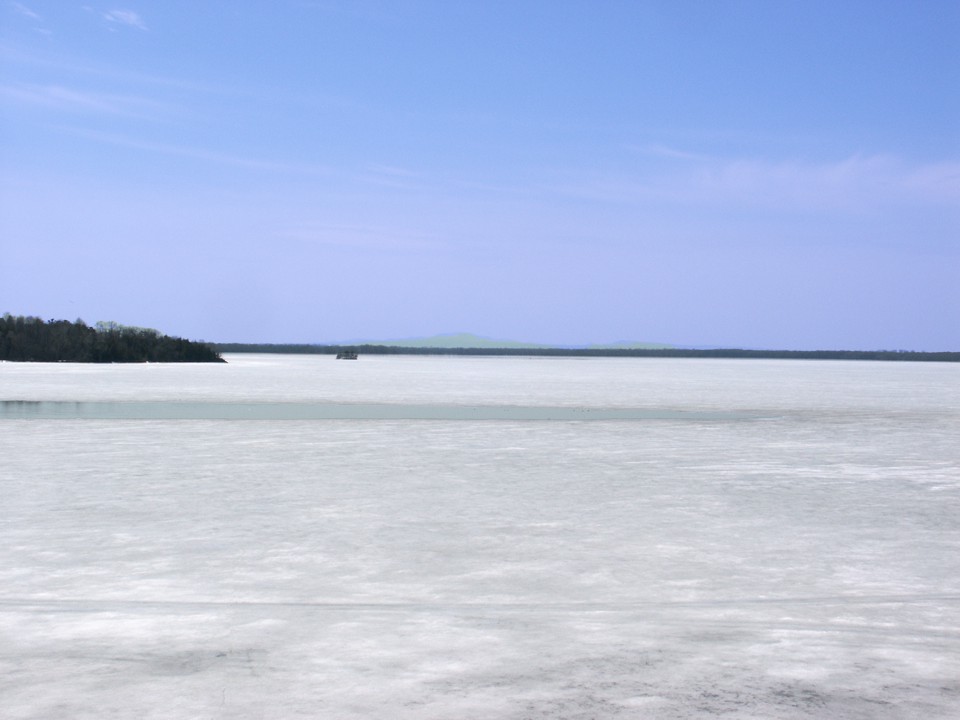
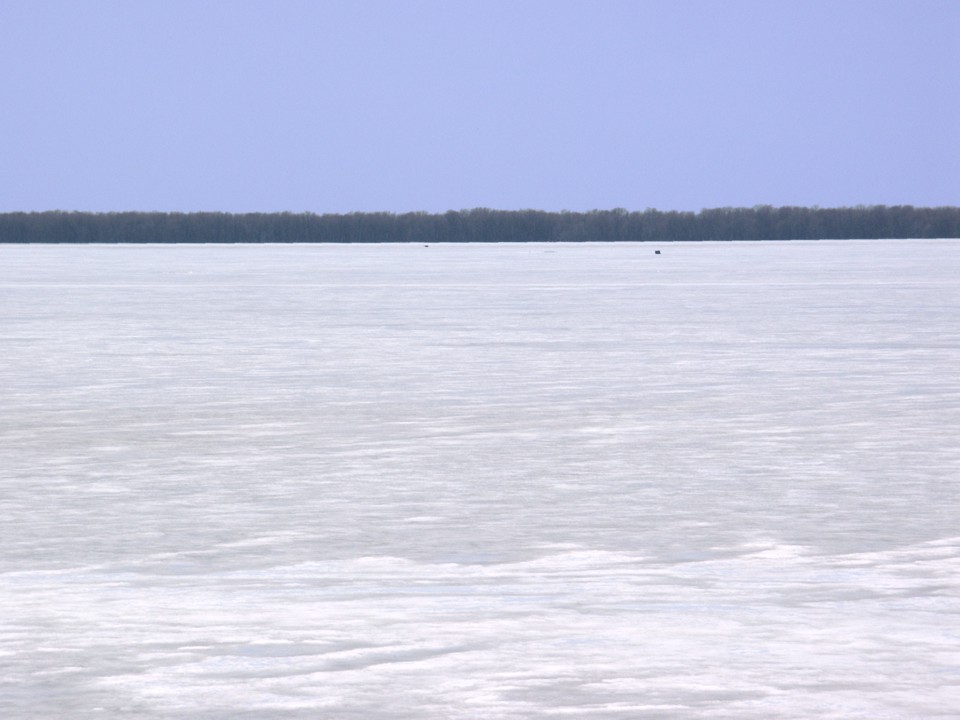
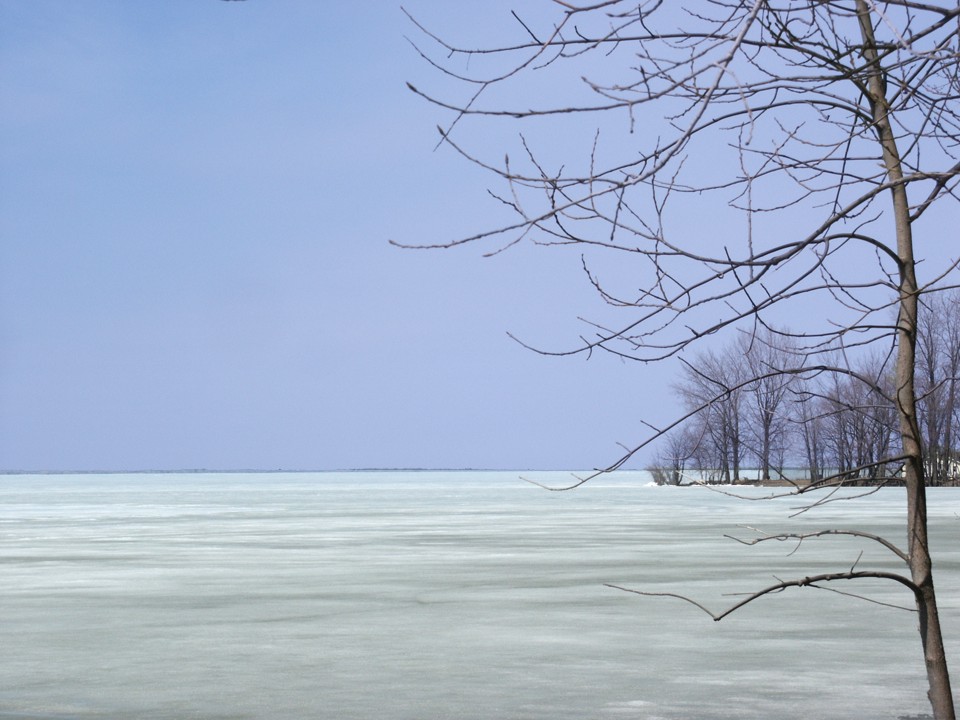
North Puffin sits directly on the shores of the no-longer-Great-but-still-pretty-darned-good-Lake-Champlain. Hard water out there, still. Ice is crucial to Vermont. Visitors come from around the world for our ice skating, ice hockey, ice fishing, ice climbing, curling, broomball and bobsled, luge, and skeleton racing. Not to mention skiing and boarding. And sugar on snow.

Burlington Harbor was still iced in as of Saturday evening but I saw open water in the Missisquoi River (upstream of the ice jams, of course) over the weekend. The plowed driveway here is largely clear and the only plowed lawn path that still has ice is the one at the bottom of the dooryard hill alongside the porch. It may not melt down in this cycle since melt water collects there and will freeze again and again and again.

Arguably the most famous ice in Vermont is the ice that isn’t. Joe’s Pond is still frozen today in West Danville but it will melt sometime in the next month or two.

Jules Chatot started the Joe’s Pond Ice-Out Contest as a cabin fever palliative in the 1980s. Mr. Chatot’s family and friends would “use his camp there as deer camp in the dead of winter, or spring break in deep snow with howling winds and muddy roads.” Sooner or later anyone there would start betting on when the ice will go out? at Hastings Store. Mr. Chatot kept track of the guesses in “a little notebook he kept in his pocket.”

A few hundred people bought tickets the first year. A couple of years later, a database replaced Mr. Chatot’s little notebook. The game has grown steadily; more than 12,000 people all around the world bought tickets last year. Ed Bird from West Danville won the first year (April 26 at 12:31 p.m.). April 16 has been the earliest and May 6, 1992, the latest. The Ice-Out Contest underwrites the free Independence Day Fireworks display.

That said, I’ll just be glad when I don’t have to warm my underwear in front of the fire before I put it on.

Plowed!

[Image]
I figure I can drive anything with wheels. The Great White Fleet right now includes a (white) pickup and an 18′ flatbed trailer, the (topless) (white) car, a more traditional (white) sedan, and a (mostly green) John Deere 2210 diesel tractor with a front end loader, mid-mount mower deck, and a 3-point snowblower. The bucket, mower, and blower are all 54″ which is a convenient width. I also have a five-foot brush hog and a five-foot swivel blade, but that’s another story. We’ve sold the race cars but in years past, I have manhandled a twin-stick Mack, lugged barrels and boats with a twin-boom fork, and shepherded race cars with and without fenders. Rufus is annoyed that I can tuck a trailer into a blind alley with 6 inches of clearance.

I’m still getting the hang of filling the tractor bucket, though. Dumping it is easy peasy but filling it while leaving nothing on the ground is still a trick.

I’ve had a chance to practice this past week.

Schools across the county had all cancelled Wednesday’s sessions before the 6 p.m. newscasts Tuesday evening as the biggest snowstorm of the season rollicked across Southern Vermont on its way to North Puffin. I had cleaned up all the open spaces just before dark so the drive was as ready as it could be. In fact, I even opened a new path to the woodshed as well.

I don’t have brine so I have to plow the old fashioned way: out in the elements, sitting high on my tractor, pushing and sometimes lifting the snow with the front end loader bucket.

Did I mention that I haz a tractor?

[Image]
“Plowing” with a bucket means pushing the snow ahead of the tractor with the bucket until you either (a) fill the bucket or (b) get to the end of the driveway. In either case, the technique at the end of the run is to lift the overflowing bucket of snow high onto a mountain of snow somewhere out of the way and deposit same. Lather. Rinse. Repeat.

Did you remember my tractor has a snowblower?

Unfortunately, that snowblower is buried at the very back of the garage, behind all the materials for the new porch construction that were supposed to be out of the way (meaning back where they belong) by Fall.

I figured then it would be OK. After all, we don’t get many big snow falls and I didn’t blow any snow at all last year. Right? Right.

Ten inches of snow by the time I plowed the third time around 5 p.m on Wednesday. I measured another three inches at bedtime and it was still snowing lightly, small, sparkly flakes. The land is really quite pretty. Weather radar shows the majority of the storm had passed us by then.

SIXTEEN INCHES.

Lordy Lordy™

And it could have been worse.

[Image]
My running total, with the Wednesday night-Thursday morning’s four inches, was just 14 inches total but the undisturbed, undrifted roof of the Mercedes told the real story on the yardstick. 16 inches. Shoveled the walk. Dragged a shovel’s width out from the south door of the porch portico so that door can open if need be. I have plowed and plowed and plowed and plowed. I moved all the new snow out of the driveway and then cleaned up the edges. I also opened up the walkway we use to get to the woodshed but still needed to plow up to the barn.

On Friday, I plowed the new snow, neatened up everywhere, opened up the woodshed again and the dooryard and made a path to the barn. Even ran the Camaro for a while to circulate the juices and charge the battery. On Saturday, I made another little path so we could get to the pile of locust since that particular wood was running low in the woodshed. I like it for overnight burns.

And then it started snowing again. Overnight.

Recall that plowing really means pushing and lifting. That’s easy when the snow is two or three inches deep because it takes most of the driveway to fill the bucket. Plow down, lift, dump. Plow back, lift, dump. Much more than that couple-three inches, though, and the lifting/dumping cycle happens with greater frequency.

I plowed Sunday in sunshine. And plowed. And plowed. Eleven inches of fairly heavy, wet snow. I had to move a lot of it by the bucket full. The lift/dump cycle for eleven inches of fairly heavy, wet snow turns out to be every ten feet or so of driveway.

27 inches of snow is more than enough. And it looks like it’s about to start. Again.

I have absolutely used up every convenient place to put snow but one and that one, at the head of the driveway, is convenient only for the circle at the head of the driveway. It’s tough to bring snow all the way there from anywhere else.

And that was kind of the point.

I can drive anything with wheels but Anne has never had much reason to. Oh, she drives pickup trucks and station wagons and garden tractors but she isn’t very good at backing up a trailer and had no “heavy equipment” experience at all.

It did snow in December and January while I was out of state. I came back here to neat piles of snow where there should be piles and no snow where there shouldn’t. The sight lines at the road were clear. And there was plenty of room for the next storm and the next. She had mastered the plow/lift/dump cycle beautifully and she did it on her own.

I wonder …

 

Getting It Up Early

I have a houseful of visitors here in the Keys. I don’t understand that. In our more than 30 years in Vermont, we can count our out-of-state visitors on our fingers. Here in Paradise, visitors are numbered like grains of sand. Anyway, our friend Missy noticed that I was “up bloody early” today (Biff was still snoring then).

“No,” I told Missy. “It is the clock that has changed. I’m up at the exact same [solar] time I get up every morning.”

Thanks to the visitors, I was actually late-ish getting to bed last night and therefore late-ish getting to sleep. Late-ish is defined as early-ish by Daylight Savings standards but later in terms of the hour at which I planned to arise. The alarm makes sure I rise correctly no matter how long the temptations of the night before seduce me.

Farmers have lived according to the sun for as long as there has been fixed base agriculture. Although my great-grandfather was a dairy farmer — I grew up on the last few acres of his farm, then made a home on the last few acres of a former Vermont dairy farm — I do not farm. I prefer sleeping in and generally like to roll out of bed about 30 seconds before I have to go to work. It also means I can see the sunset, the moonrise, and the clocks strike midnight.

Clock setting is arbitrary, all because somebody in “the dawn of time” jammed a stick in the ground and decided that getting his farm workers up at 4 ayem was a good idea. Some of us don’t agree. Russia’s 11 time zones are all an hour ahead of the corresponding standard time zones and double that during DST.

Ben Franklin wrote satirically that Parisians should go green and save candles by rising earlier to use morning sunlight. He didn’t seriously propose Savings Time, though, no matter what you read on the Internoodle. That honor falls to George Hudson, an amateur New Zealand entomologist who wanted to collect insects in after-work daylight.

I don’t understand why we don’t just choose a time we like permanently.

Arizona, Guam, Hawaii, Puerto Rico, American Samoa, the Virgin Islands, most Indiana on Eastern Time, don’t switch their clocks. Arizona remains on Mountain Standard Time year round. They, along with India, China, and Japan are the major industrialized states that are constant UTC+something 12 months out of 12, while the rest of us spend seven months of the year with “extra” daylight and nearly five months without.

Not even all of Arizona is exempt. The Navajo Nation does observe. The Navaho have the largest land area of any Native American jurisdiction within the United States with 26,000 square miles that covers all of northeastern Arizona, the southeastern portion of Utah, and northwestern New Mexico.

Changing the clocks irritates me but I’m not rabid about sticking on solar time except I have a regular morning phone call with one of the non-mainstream states.

A friend who lives there “finds it irritating that we have to rearrange our meetings every time all y’all flip to another time, and irritating that I have to think “Is it two or three hours different when I call my dad? Is it one hour or the same when I call my daughter or mother?”

Exactly.

My choice is to synch my own schedule rather than force the others on that call to rearrange theirs.

It just seems bloody early to start the morning to Sally. And to me.


For the record, my European web host thought this post went up at 13:00.