No Trespass, No Launch

You can go pretty much everywhere and see pretty much everything in Florida from the water. That’s particularly true here in the Keys. Unless you happen to be on Card Sound.
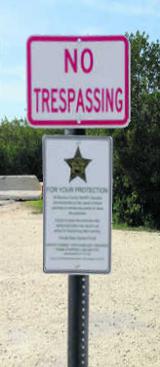
No TrespassingMonroe County has found another use for Jersey barriers, boulders, and “No Trespassing” signs: the Sheriff closed down four public access areas near Card Sound Bridge including the Jet Ski Beach. County officials blamed “excessive weekend parties” and rowdiness left the area littered with trash not to mention the graffiti. Four popular Card Sound Road spots are now forbidden territory. Illicit. A no-no. Out of bounds. Gone.

For littering.

Yeah, as if a couple of signs will stop the parties.

Hang on while a couple of bars of the menu at Alice’s come around on the guitar.

I understand the idea of attractive nuisance.

“The attractive nuisance doctrine states that a landowner may be held liable for injuries to children trespassing on the land if the injury is caused by a hazardous object or condition on the land that is likely to attract children who are unable to appreciate the risk posed by the object or condition. The doctrine has been applied to hold landowners liable for injuries caused by abandoned cars, piles of lumber or sand, trampolines, and swimming pools. However, it can be applied to virtually anything on the property of the landowner.” (USLegal)

That (presumably) doesn’t apply to a public parking area but I also understand what municipalities think the attractive nuisance doctrine means.

“The doctrine states that pretty much any improvement you put on public land will attract some nuisance who will hurt himself and sue our asses collectively and individually. As a corollary, that nuisance will make a mess.”

(The Florida Department of Transportation has also shuttered Sea Oats Beach on Lower Matecumbe Key. Reason: trash.)

The FWC page describes these access areas as “Government Owned for General Public Use.”

The nearest (free) launching ramp in Monroe County is now about 40 miles south at Indian Key fill in Islamorada. I’ve never launched up there but plenty of pro fishermen and fishing guides have.

Since the guides use it, that sounds like restraint of trade to me.

For littering.

Remember when the nun lined up all the boys and said, “There will be no recess until the bad boy who wrote ‘sister sux’ on the blackboard comes forward”?

That was bad parenting then, too.

 

A Distinct Smell of Fish

Marathon, Florida incorporated as a city in 1999 for the obvious tax advantages. See, cities have taxing authority. It scrawls across Knight’s Key, Boot Key, Key Vaca, Fat Deer Key, Long Point Key, Crawl Key and Grassy Key in the middle Florida Keys, right next door to beautiful South Puffin. The population was 14 in 1820 and reached a peak of 10,626 as of the 2005 U.S. Census estimate.

8,461 souls make Marathon home today.

Marathon’s Finance Chief oversees the city checkbook on a contract basis. Bishop Rosasco & Company gets paid $384,063 for their fiscal year 2013-14 contract.

384,063 U.S. dollars.

8,461 people.

As a comparison, St. Albans City, Vermont, had a population of 6,918 in 2010. It is right down the road from lovely North Puffin. In 2014 St. Albans City, Vermont, budgeted $52,530 for finance and a huge additional cost of $9,000 for audit and audit consulting.

$384,063. $61,530
8,461. 6,918

Wow.

Taxes Going Up. No Down. No Up.

I helped to found and was the first chair of the Parent Support Group at Missisquoi Valley Union High, the 7-12 public school my kids attended.

The new high school opened in Highgate, Vermont, just outside the village of Swanton in 1970. The school district is a union of Franklin, Highgate, and Swanton kids. An unusual series of interconnected circular buildings called pods with a network of outdoor paths serve about 1,000 students.

I never liked the name (we were parents supporting the kids and the school, not parents getting psychological help) and the architecture was a mistake in the frozen north, but I did like the group.

MVU was in trouble by the 1980s. Student morale was down. Teacher morale was down. And no one in the community liked the place.

Graduation rates were low. Teachers earned less than shelf stockers in Ames. And the moat around the school widened the town-gown divide.

We did a lot. We opened the front doors wide and drained the moat. Started a goal setting group and an arts council. Promoted the change from “junior high” to “middle school.” Championed pay parity for teachers and learning parity for students. Got the Gov on stage. Test scores rose. Salaries rose. Community spirits rose.

Unfortunately, test scores have fallen, salaries keep rising, and community spirit is back in the toilet.

I blame part of that on the isolationist feel that creeps into so many schools.

I blame more on salary creep. See, the average salary for a professional teacher is now significantly higher than the average wage for the taxpayer paying that average salary. Worse yet, Joe the Plumber sees immediate results when he does a job — the leak stops. Then Joe the Plumber sees that test scores at the professionally run school keep hemorrhaging.

And school taxes, now collected by invisible people in Montpeculiar, keep on going up.

Vermont Business Week reported that a Vermont House committee will “increase the statewide property tax rate for fiscal year 2015. The homestead rate will go up 4 cents and the non-residential rate will go up 7.5 cents under the House Ways and Means Committee proposal. In December, the forecast for the rate was 7 cents for homestead property taxpayers.

“The committee was able to reduce property tax rates because statewide school spending increases were less than expected.”

Lemme see if I have this right.

“The homestead rate will go UP 4 cents and the non-residential rate will go UP 7.5 cents…” but “the committee was able to reduce property tax rates.”

That has to win the doublespeak award for 2014.

Once upon a time a property tax reduction meant that your taxes (and mine) would go down. “The homestead rate will go UP 4 cents and the non-residential rate will go UP 7.5 cents…”

Good that we are teaching such fine arithmetic in Vermont these days. Must be those Common Core standards.

“Prove in 112 steps that a change from 94 cents to 98 cents is a decrease of 4 cents.”

Annie - the MusicalMVU has some great programs. The school musical, long a community favorite, is Annie this year. It takes the stage in the school’s world class theater on Thursday. Caroline Bright of Franklin, the 2010 Miss Vermont, is an MVU graduate. MVU won the large gold traveling trophy champion of the 2013 Vermont Treasury Cup Challenge, an academic challenge of personal finance and economic knowledge.

But.

I’m now an outsider looking in at the school my children invested in. What I see saddens me.

What I see is the state charging us more and more and the school giving us less and less.

The $15.7 million MVU budget would cost about $16,000/per student. That budget was defeated.

MVU has fewer students this year than it did in the 1980s. MVU has more “educators” this year than it did in the 1980s. MVU ranks 42 out of 53 Vermont high schools on the 11th grade NECAP Mathematics and the NECAP Reading assessments (we don’t call them tests anymore). Two Franklin County schools are in the bottom fifth: MVU at #42 and Richford Junior/Senior High School at #49. Enosburg Falls Junior/Senior High School almost made it at #39. It gets worse. MVU also ranks 79 out of 86 Vermont middle schools on the NECAP 8th grade Mathematics and Reading tests. That’s the bottom ten percent. Heck, even the top ranked Vermont school still has more kids falling behind than surging ahead.

I’m glad to report the outdoor paths between MVU classrooms have been moved inside. That didn’t help test scores.

It’s time to wrest our school back from the people who think rising taxes cost us less. It’s time to wrest our school back from the people who think the best way to fix falling test scores is to stop giving tests. It’s time to wrest our school back from failure.


Pay Me

Almost 50 years ago, my mom’s friend Eddie Maranowski was a photographer for the Daily Local News but he also owned a shoe store right next door to the Warner Theater where I was an usher.

Eddie hired me for a promotion for a brand of shoe he sold. I was the (very local) “Kolonel Keds” for the opening of a now-forgotten movie at the Warner. I greeted kids, handed out trinkets, and looked heroic.

Keds™ is an American brand of canvas shoes with rubber soles introduced in 1916 by U.S. Rubber (the company later known as Uniroyal). In 1960 they became the first mass-marketed canvas-top “sneakers” because the rubber soles let us sneak up silently on spaceships. Kolonel Keds flew Bell™ jet packs, rescued kids, and extolled the virtues of the scientifically designed, built-in booster pad in the shoes.

Eddie gave me a few bucks and a brand new pair of sneakers. I didn’t get to keep the Bell crash helmet, though.

Keds logo
I got paid to wear the logo. There’s a lesson there.

Everybody wants to “monetize” the Interwebs. “It’s been 25 years of ‘free free free’,” Internet inventor Al Gore said. “It’s time we start understanding nothing is free.”

I agree.

See, when you hear an expert say we should monetize anything you know he means he wants money to flow from you to him.

That’s backwards.

Ralph Lauren wanted me to embroider his polo pony on my shirt for free, not to tell the peeps I met how cool I am but to market his shirt to the peeps I meet. He never responded to my request for a share of the profits, so I don’t wear his shirts. On the other hand, I painted Lanson Machine on the fenders of the race car because they did pay for that.

Data is the currency of the Internet.

The World Economic Forum in a 2011 report called personal data the “new oil.” Data brokers estimate information about you is worth a fraction of a cent for a single piece of data to $5,000 or more for a full digital profile.

The Denver Post had 25 trackers on a recent visit: Adblade, AddThis, BrightTag, ChartBeat, Crowdynews, DoubleClick, Facebook Connect, Google +1, Google Adsense, Google Analytics, LinkedIn Widgets, Lotame, Mixpanel, NDN Analytics, New Relic, Newstogram, Omniture (Adobe Analytics), Outbrain, Press+, Quantcast, ScoreCard Research Beacon, Twitter Badge, Twitter Button, Tynt, and Visual Revenue. Surprisingly, nytimes.com set only seven the same day: Audience Science, Brightcove, ChartBeat, Conviva, Dynamic Yield, Google Analytics, Krux Digital, New York Times Beacon, ScoreCard Research Beacon, and WebTrends.

Judge Lucy Koh of the Northern District Court of California found last year that Google might have violated wiretap laws.

It’s time the money start flowing from them to us. Amazon wants to set a tracking cookie to see where I click next? That’ll be one cent, please. TVGuide wants to sell a third-party cookie so someone else profits from where I click next, too? That’ll be a nickle, please. Verizon wants to know where I am to connect my phone call? Cool. Verizon wants to sell where I am to the donut shop? I want a dime for that. Andy Monfried might sell my email address to ABCMegaUltraCorp? I get a tenth of a cent each time. Spamford Wallace emails me an ad for a penis reduction tool. That’ll cost him a buck. For the record, I never did collect from Spamford.

This could work. All we need is a micropayment system to collect it and pay us.

A micropayment is just what it sounds like: a very small sum of money that usually transfers from my account to yours (or vice versa) online. Unfortunately, ystems that allow transactions like these, from fractional pennies to a few cents each have seen little success so far. W3C (the World Wide Web Consortium) planned to include micropayments in HTML but those efforts have stalled, so there are no widely used micropayment systems on the Internet. CentUp is a mostly blogging and podcasting system that collect donations for content. I haven’t seen many sites that use it. Flattr uses actual banks. M-Coin and Zong charge your phone bill. PayPal will do charges under $12 but their fees are high. IBM and Visa are among the big operators who have tried and failed. It was just too expensive, I guess. Bitcoin might work.

Once upon a time, businesses spent money directly — with surveys and coupons or discounts on their products, for example — to harvest data about us and to mail us enticements to buy more. Now they want to do it for free. Eddie paid me to help him sell those sneaks.

Who knows? A side benefit might be to the post office. If we raise the cost of entry high enough, advertisers might just go back to snail mail.


Diminishing Expectations

“We’ll insure 30 million Americans who don’t have insurance,” Barack Obama said in 2008.

“We’ll insure 27 million Americans,” Barack Obama said in 2009.

“We’ll insure 15 million Americans by 2013,” Barack Obama said in 2011.

“We’ll insure 7 million Americans by March of next year,” Barack Obama said when he moved the deadline in 2013. Again

“We’ll insure 6 million Americans by March 31,” the White House said in last week.

“We’ll insure 2.8 million Americans by 2016,” the White House will say in July.

According to the U.S. Census Bureau, 48.6 million Americans had no health insurance in 2009, 50% more than Mr. Obama originally promised Obamacare would originally cover. “There are still more people uninsured today than when Obama was elected president,” U.S. Rep. Jack Kingston (R-GA) said recently.

He’s mostly right. 15.4% of Americans were uninsured during the first quarter of 2009. That’s 47.7 million folks. 15.9 percent of Americans are uninsured today. That’s 49.9 million folks.

The Obama administration’s original goal was to enroll 30 million 15 million 7 million^H^H^H 6 million people by the end of the open enrollment period on March 31. Around 20% of those will fail to pay and most of those who do follow through already had had insurance that Mr. Obama cancelled.

That’s today.

Do you have insurance? Today is your last day to sign up.

Do you have insurance today?

45.1 million Americans won’t.


And the hidden gotcha: your premium in 2015 will be significantly higher than those in 2014. Aetna and WellPoint predict that most carriers will raise rates by “double digits.”  So will your taxes.


BREAKING NEWS: healthcare.gov was down again for much of March 31 under the crush of the tens of people trying to sign up at the last minute.