Swearing In

This is the story of my second biggest contribution as a Republican Town Chair but first I have to give you some back story.

Back story 1: Fifty years ago, on August 6, 1965, President Lyndon Johnson signed the Voting Rights Act, the sweeping law that assured the right to vote for all Americans by prohibiting the practices used to deny that right to racial, ethnic, and language minorities.

“Many people don’t understand that … the Voting Rights Act is under threat.” Sen. Cory Booker, D-NJ said. “These voter ID laws which are being passed in many states have a disproportionate impact on poor folks.” The senator has introduced the Voting Rights Advancement Act aimed at preventing voter ID requirements.

I won’t comment on voter ID except to note that voting is our most important obligation and that the other advantages we have come to expect — driving our cars or picking up a book at the library — require identification.

Back story 2: In Supporting Parents I promised to tell what Vermont’s future governor and I were joking about on stage in 1984.

My friend Jim Douglas was Vermont’s Secretary of State then.

The office of Secretary of State pre-dates Vermont statehood in 1791.

The voter’s oath, formerly known as the freemen’s oath, is a citizen’s oath required to register to vote in the state of Vermont. Until 2007, the law was administered only by notaries public and similar officials.
The Freemen’s Oath was a part of the 1777 Constitution of the Vermont Republic, the first constitution in the Western Hemisphere to grant universal suffrage to all men. Until the early twentieth century all official state commissions and certificates were headed by the words “BY THE FREEMEN OF VERMONT.”

The agency manages the State Archives so he preserved all state records and made them accessible to the rest of us. The State Archives preserve documents going back to the state’s founding as the Vermont Republic in 1777. The office licenses 39 different flavors of professionals from accountants and acupuncturists to tattooists and veterinarians. They register businesses and oversee all of Vermont’s notaries public. Most important to this story, they administer all national, state and local elections in Vermont, register voters and coordinate the Voter’s Oath, oversee campaign finance reporting, and implement Vermont’s lobbyist disclosure laws.

You solemnly swear (or affirm) that whenever you give your vote or suffrage, touching any matter that concerns the state of Vermont, you will do it so as in your conscience you shall judge will most conduce to the best good of the same, as established by the Constitution, without fear or favor of any man.

Vermont is the only U.S. state with a voter’s oath.

My second biggest contribution as a Republican Town Chair was swearing in new voters. At that time, only a Notary Public could administer the Freeman’s Oath; that’s the only reason I was a notary. I carried voter registration forms in my car pretty much everywhere because one just never knew where a potential voter might lurk.
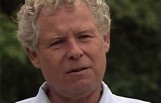
Gov. Dick Snelling, R-VTA lot of them lurked at our local high school so Jim Douglas and I cooked up a Voter Registration assembly and civics lesson. Today pretty much anyone over the age of 18 who fogs a mirror can administer the oath, including the potential voter but back then only Notaries Public (actual or de facto) could give the oath. Town Clerks are de facto notaries so they swore in voters all the time. Other elected officials are not which means they can’t.

About 20 years after the passage of the Voting Rights Act, we filled the school auditorium with the older kids and put a couple of Dicks on stage.

Dick Snelling was the 76th and 78th Governor of Vermont. He jumped at the chance to talk to the kids when I asked him to drive up.

I introduced him. He got the crowd worked up in a few minutes and then invited anyone who wanted to register to come up on stage with us.

Our plan was that he’d greet the kids and keep them a little amped while Jim and I did the grunt work of filling out the forms and administering the oath.

The Gov. had other ideas.

“I’m going to swear in at least the first kid,” he told us.

Dick Snelling was a lot of things, but the Secretary of State who knows these things knew he wasn’t a notary. The Secretary of State who knows these things also knew that you have to be a notary to give the oath.

Jim and I looked at each other. “You going to tell him?” he asked.

“Not I.”

I think we registered about 40 kids that day. Most of them still vote.


How do I register to vote [in Vermont]?
If you are registering to vote in Vermont for the first time by mail, you must include a photocopy of an acceptable form of ID. Acceptable forms of ID are: Valid photo ID (driver’s license or passport); current utility bill; current bank statement; another government document.

Am I required to show identification when I vote [in Vermont]?
No. In Vermont, only first time voters who have registered by mail have to show ID in order to vote. If you registered when you renewed your driver’s license, or as part of a voter registration drive, you will not be required to show ID.

What kind of identification do I need to bring to the polls [in Florida]?
When you go to the polling place to vote, you will be asked to provide a current and valid picture identification with a signature. Approved forms of picture identification are: Florida driver’s license; Florida identification card issued by the Department of Highway Safety and Motor Vehicles; United States passport; debit or credit card; military identification; student identification; retirement center identification; neighborhood association identification; and public assistance identification. If the picture identification does not contain a signature, you will be asked to provide an additional identification with your signature.

Can I still vote [in Florida] if I do not bring identification?
Yes. You should not be turned away from the polls because you do not bring identification. If you do not have the proper identification, you will be allowed to vote a provisional ballot.
 

Strike!

“We need to go on strike!” My friend Lido Bruhl shouted.

From the You Can’t Make this Stuff up department.

“They can’t rise if the minimum wage is too low to live on,” democratic candidate Hillary Clinton said in a speech Friday.

The minimum wage is the least an employer can pay an hourly employee; it has been pegged at $7.25 an hour since 2009; some states and cities have raised their minimum wage higher than that.

Many politicians want to raise it to $15/hour.

Just 4.3% of hourly workers 16 years old and older earn at or below the prevailing minimum wage but 42% of all U.S. workers earn $15 or less. Since about 60% of the U.S. workforce of some 122.9 million full time workers overall are paid hourly, more than 70 million workers now make less than that magic $15/hour. (BLS defines full-time workers as those who usually work 35 hours or more per week.)

“We need to go on strike!” Lido “Lee” Bruhl is a now retired newspaper editor who lives on Social Security with help from his wife and his daughter Greta.

Wait.

What?

What’s a state-run lottery?
It’s another extra tax on people who can’t do math.

Let’s start with some basic facts about Social Security today.

“If it weren’t for Social Security more than one-third of us older Americans would be living in poverty,” he said. “As it is, we worked all our lives and now we’re living on minimum wage!”

Wait.

What?

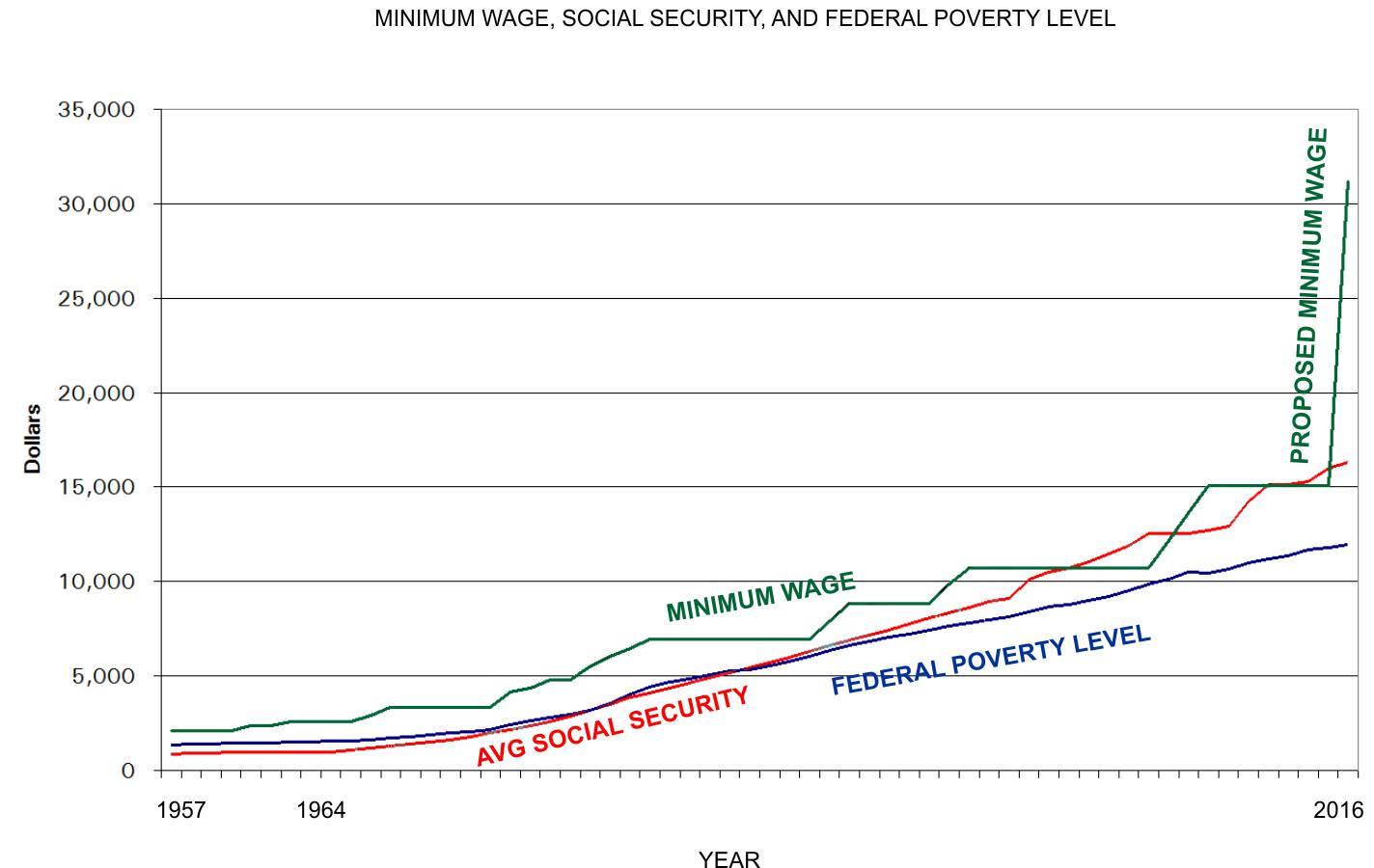
Regular readers may recall a chart I created last year to compare the minimum wage with the Federal Poverty Line. People working for minimum wage have consistently earned more than the Federal poverty level every year since 1957. Here are those figures updated.


2016 Minimum Wage Chart

Among “elderly” Social Security recipients, 22% of married couples and about 47% of unmarried persons rely on Social Security for 90% or more of their income. Ouch!

There are 41,362,000 elderly recipients. About half of them receive the average “benefit” of around $1,300 per month or less. That’s about $43 more per month than minimum wage. And it is considerably less than that after deducting for Medicare premiums.

The definition of poverty is income below $11,770 this year. Working 40 hours at minimum wage earns you $15,080. (Heck, if you work 35 hours at minimum wage, you earn $13,195.) And the average Social Security check will bring in $15,988 this year.

We don’t need to argue about whether “poverty” in the United States doesn’t look at all like the hand-to-mouth existence of the poor in, say, Mexico. If you can afford cigarettes and a smart phone, you aren’t poor.

“I don’t smoke. I can’t afford it,” Lee said. “I don’t have a smart phone for the same reason.”

Now for the politics (and you thought I’d never get here).

The American retirement system is designed so smart politicians can keep American workers and retirees alike in servitude to the government but the idea of raising the minimum wage is designed for people who can’t do math.

Want to know why politicians want the minimum wage to rise?
The income tax you pay goes up when your paycheck goes up.

Want to know why politicians want wages to rise?

It’s simple. The income tax you pay goes up when your paycheck goes up. The income tax rate you pay goes from zero at minimum wage to about 13%, meaning you’ll owe $4,060 when your paycheck goes up to $15/hour. All those new taxpayers.

What happens when 70 million people get a raise to $15/hour?

The first thing that happens is a brief surge in government revenues as payroll taxes skyrocket.

The second thing that happens is 25 million people get their hours cut. The politicians forgot that part.

The third thing that happens is 25 million new unemployment applications. The politicians forgot that part.

The fourth thing that happens is 10 million pissed off workers because they no longer make more than minimum wage. The politicians forgot that part.

The fifth thing that happens is an inflationary spiral. The politicians forgot that part.

The sixth thing that happens is an increase in the Federal Poverty Level. The politicians probably remembered that part.

And almost 21 million Social Security recipients won’t be able to afford the stamp to write to their Congress Critter because they will suddenly be back under the poverty line.

My friend Lee Bruhl was right.

We need to strike.

He’s just wrong about the reason.


No Respect

Bagpipes get no respect.

Q. What’s the definition of perfect pitch?
A: When you toss a banjo in the dumpster — swish, nothin’ but net — and it hits the bagpipes.

We went to a roots music concert last week, one in which I was the announcer. There was a piper but I was good. I didn’t tell a single bagpipe story and it about killed me not to.

I live in the middle of the Florida Keys on an island I can drive to. Three generations of my family has owned that house, so we have some history but we are newcomers compared to the real conchs.

Q: What’s the first thing a bagpiper says when he knocks on your door?
A: “Pizza!”

I wasn’t even born when the (pre-Global Warming) Labor Day hurricane destroyed the Florida East Coast Overseas Railroad or when Key West’s Mallory Square was the anchorage of pirates, the the center of the shipwrecking industry, or the assembly point of American forces for four wars.

I also missed the Mallory Square Sunset Celebrations of the 60s when the hippies and gypsies and freaks would watch Atlantis rise mythically out of the sunset clouds.

My first drive across the 7-Mile bridge was an eye opener. Florida DOT built the road on top of Henry Flagler’s historic “railroad that went to sea.” They poured two narrow lanes of concrete, then painted the old tracks white and used them as guardrails. The lanes were so narrow that two trucks would slap mirrors passing. Until 1982, when the adjoining new bridge opened, it was the only road cars could take to Key West.

My first memory of Mallory Square in Key West was a funky free-for-all with creosote piers and gravel and street vendors. The Cookie Lady was there as were artists and jugglers, jewelry crafters and a cat herder, and the southernmost bagpiper.

Alfred Hitchcock once said, “I understand the inventor of the bagpipes was inspired when he saw a man carrying an indignant, asthmatic pig under his arm. Unfortunately, the man-made object never equaled the purity of sound achieved by the pig.”

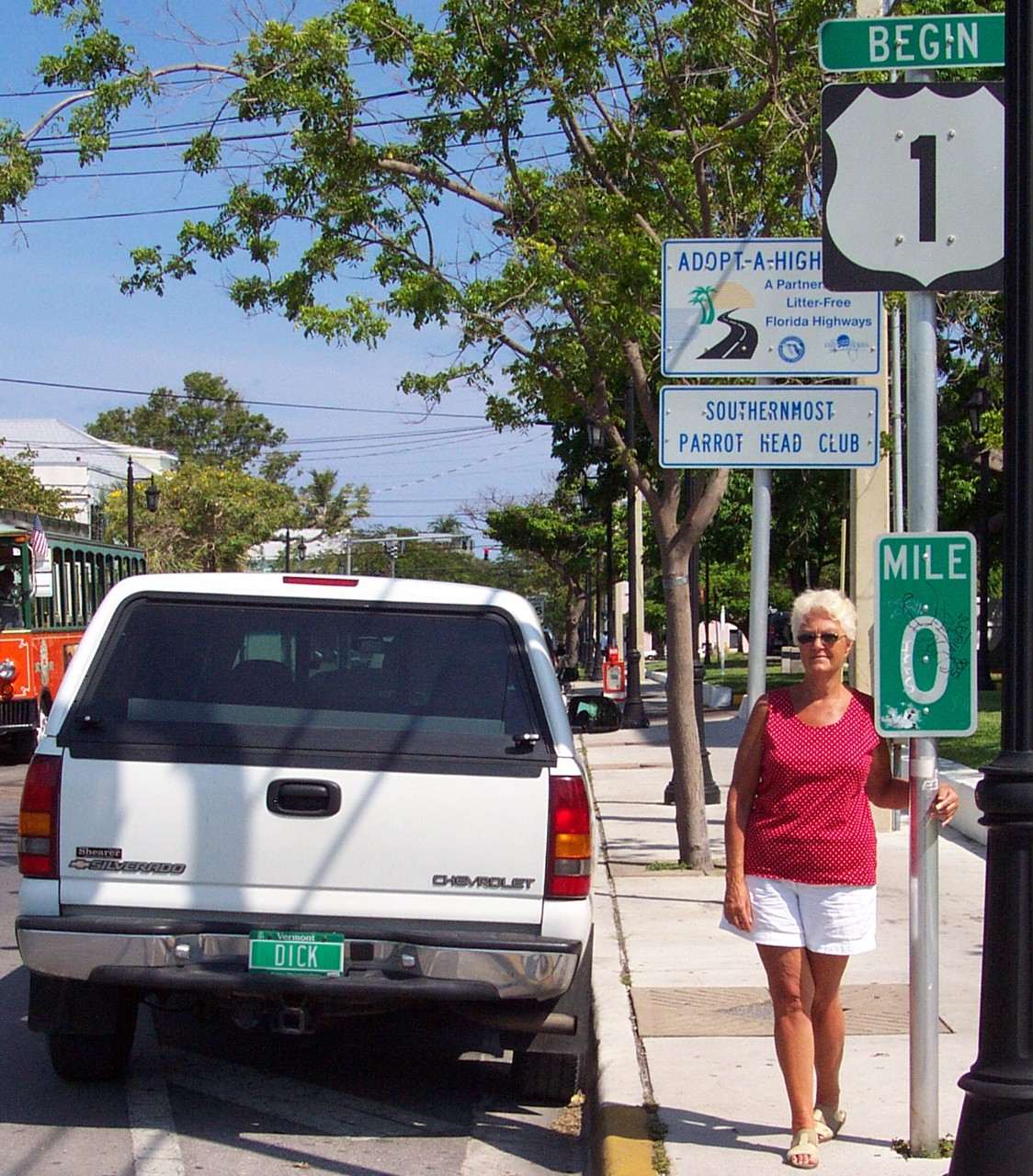
We’ve done the proper touristy stuff. We took selfies at mile marker 0 and at the Southernmost point. We have paraded with the pets at Fantasy Fest. And we have dangled our feet over the edge of the pier, waiting for sunset.

You can’t do that at Mallory Square any more. It is too clean, too concrete and the cruise ships have replaced the pirates.

Will Soto was setting up his high wire poles one evening when SWMBO and I were indeed sitting on the edge of the pier with our (bare) feet perhaps a yard or so above high tide.

“Tonight will be the best night of the year,” Mr. Soto said to us as he set one pole right behind us. He wandered away, pulling his wire with him and worked on the other pole.

Then he came back.

“Tonight will be the best night of the year,” he said again as he tightened the two guy wires. I figured this was just the normal hyperbole, drumming up trade. We were, of course, the trade. This combination of work and commentary continued for a couple more round trips.

He finally went back to the other pole to do the same and then returned.

“Tonight will be the best night of the year,” he said and I couldn’t stand it any longer.

“Why is that,” I asked.

“The bagpiper called in sick.”