
Wordless Wednesday
I take the odd photograph or two and have an ongoing juggling act with digital memory cards. We don’t have to keep film in the fridge or rush it to the lab any more but we do have to handle the huge RAW image files our increasingly large capacity cameras generate.
“I am going to look at the Eye-Fi memory card,” Liz Arden said.
Whoa. This is really cool. And my first thought was, Can it be programmed to go to Dropbox or just to my home network?
Warning: This is going to be a techie column.
Eye-Fi gets media where you want it:
During the quick set-up, you customize where you want your memories sent. The Eye-Fi card will only send them to the computer and to the sharing site you choose. Pick from one of over 25 popular sites including Picasa, FB, and more, but not Dropbox.
“Picasa works for me,” Ms. Arden said. Me, too.
Before I start to sound like a press release, the downside is that Eye-Fi cards are Secure Digital (SD) based only. I settled on Compact Flash long ago. The latest (camera) body I lust for as well as my current cameras are not compatible with any Eye-Fi cards because Eye-Fi doesn’t work with that storage media.
The Mac Geek Gab guys who introduced them to Ms. Arden “didn’t quite grouse about CF cards, but didn’t like that some cameras use them when SD is so prevalent that the makers of these devices don’t feel a need to do the same for CF.”
And that was a mistake on the camera makers’ part.
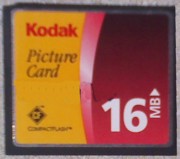 I settled on CF because it was the fastest, highest capacity, least expensive media and the cameras I like best use it. And it came standard with the first digital camera I bought, a Kodak DC4800.
The data backs me up. The Compact Flash can support capacities up to 137GB although mass market cards rarely go above 64GB. UDMA 133 has a data transfer rate of 133 Mbyte/s. And current cards are rated for 1,000,000 writes per block before hard failure which will long outlive my camera shutter. Looks like Secure Digital cards max out at a capacity of 32GB and have write rates of 200 Mbit/s (bits, not bytes.)
Even the Wikipedia article admits that “SD cards … may also not present the best choice for applications where higher storage capacities or speeds are a requirement as provided by other flash card standards such as Compact Flash.”
The Canon 5D Mark II was the first DSLR to shoot full HD video. With a 21.1 million pixel sensor, each shutter click writes a 25.8 MB file on the Compact Flash card. The standard CF card originally packaged with the camera will hold 78 JPEG files or 13 RAW files. I don’t even want to think about an HD video on the same “little” 512 MB card I use in the Kodak today. A modern digital photographer might carry three times more memory cards today than film canisters of 20 years ago.
I’m always looking for a better way to move the files from the camera to the laptop.
CFMulti advertises that it “opens new possibilities for Compact Flash (CFII) equipped devices.” This gadget puts an Eye-Fi WiFi SD Cards into a CF-shaped which plugs into the Type II slot. “Since most current high end DSLR and late model midrange digital cameras feature CompactFlash slots, CFMulti’s ability to provide them with Eye-Fi wireless protects camera investments.”
Better but it still uses the slower, lower capacity SD cards.
We’re getting closer to the grail.
That would be a medium format digital camera that writes a 4MB RAW file over 4G or WiFi in a tenth of a second. Maybe next year.
Mr. Grove promised, you know.
!@#$%^&^ COMCAST BILLED ME FOR THAT SERVICE CALL LAST MONTH.
And then I got the doomsday letter.
“XFINITY is coming. Soon you’ll enjoy TV, Internet anc Voice service made possible by Comcast’s upgrade to an all-digital platform … equipment may be required to receive ALL channels.“
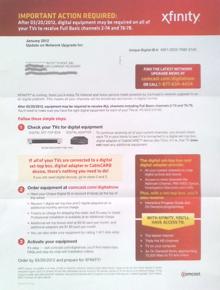 The !@#$%^ Comcast office was crowded and had just two reps manning the counter. When I got to the counter, I told the rep that all I have are channels 3-20 and asked if I needed a converter or if the most basic basic channels would remain analog. The rep said I needed it. Then I asked about changing channels.
“Oh, you just set your TV to Channel 3 or 4. It’s easy,” she ‘splained.
“No. How do I change stations when I’m recording with a VCR,” I told her. “Say I want to record channel 7 at eight o’clock, change to channel 10 at nine, and channel 4 at ten?”
“Let me get you a service technician.”
He told me that wasn’t possible but, he said, I didn’t really need the converter because channels 1-26 weren’t scheduled to go digital.
Cool. I almost left right then but the rep contradicted him.
“All the channels will switch March 15,” she said.
Swell. Now I have three digital boxes that give me less service than my zero current digital boxes since THEY CANNOT BE PROGRAMMED TO CHANGE THE CHANNEL.
Yes, I am shouting.
And it took more than an hour to get them.
I get to pay more per month for less service. And that’s the story of dealing with !@#$%^ Comcast.
On the other hand, I met the man who owns the DC-3 in Marathon and I bought a yellow croton, so the day wasn’t a total loss.

1. Whitehouse.gov has a petition to the Obama administration to “require automakers to replace the nearly useless Check Engine Light with a display that actually explains what’s wrong.” The petitioner says “we need a federal mandate…”
Say what?
“Yeah, like that’s what we want governance to do,” my friend Liz Arden said. “We really want the Administration to replace its mission for social engineering with even more automotive engineering.”
2a. Meanwhile, in the real world, America’s poor use food “stamps” to buy staples like milk, vegetables, fruits and meat. Technology update. The coupon book has morphed into a debit card. A Florida state senator wants to stop them from using the food stamp cards to buy sweets like cakes, cookies, and Jell-O and snack foods like chips. She also wants to limit other welfare funds, known as Temporary Assistance For Needy Families, from being used at ATMs in casinos and strip clubs and anywhere out of state.
Ya think?
“That’s something of which I would approve,” Ms. Arden told me. If our government insists on “spending our tax money helping out the poor, then social engineering in this respect is appropriate. My tax dollars are not a gift to be used by the recipient as they please — they are an investment in this country’s good. ”
The Florida bill recently passed committee. Liberal critics say the government shouldn’t dictate what people eat.
“Gummint isn’t,” Ms. Arden said. “They may use any of their own earned dollars to eat snack foods and go to strip clubs.”
But, but, they are poor. That pretty much means they don’t have their own money, yes?
“Then work hard to get off the public teat so you can afford to have Twinkies and Ho Hos.”
I’m not sure I’d even call it “social engineering.” I’d simply call it a grant requirement. Or a contract. Or the law.
Grant recipients have to jump through specific hoops for their funds (a college lab can’t spend the money it gets to research norovirus on, say, staff mammograms even if that’s a good thing to do). And, just as an aside, the letter carrier who delivered the welfare check or food stamp card in the mail passed a criminal-history check, a physical examination, and a drug test.
2b. On the other hand, the ACLU here in Florida brought a class action suit last year to stop drug-testing welfare recipients. That’s probably social engineering because I’m thinking very few street dealers have the required credit card machines. That makes it hard to use food “stamps” for crack or meth.
3. At the other end of the spectrum, Liz Arden does think the Federal gummint should get out of the marriage business altogether. “It’s a contract and Congress is trying to social engineer it,” she says. “Let the churches or the Towns or even just the individuals download a form or call a lawyer and just do it.”
That’s a good Libertarian response to a Congress that is either hellbent on destroying marriage or saving it. Or both. Or not doing anything at all.
Congress is nothing if not schizophrenic.
Except contracts don’t bind parties outside the contract to their terms so a private marriage contract can’t by itself change HIPAA, can’t override probate laws, can’t affect the tax code, and can’t protect child brides, people of unsound mind, or close relatives (you cannot, for example marry a parent, grandparent, sister, brother, child, grandchild, niece, nephew, aunt or uncle in Vermont). United States federal law is supposed to assure that a marriage licensed in one state is recognized in all the others, a pretty important fiat. And the Supreme Court overturned state marriage laws that barred interracial marriages on the basis that marriage is a “basic civil right…” Not a likely outcome for a private contract.
Government must not/must mandate Idiot Lights.
Government must/must not mandate food stamp junque food.
Government must/must not mandate welfare drug tests.
Government must not/must mandate marriage.
The Check Engine or Service Engine Soon lights aren’t necessary to the well-being of American society. Period.
The junk food and drug test orders do improve the well-being of American society. Worth running through the legislature.
Marital contracts deserve the same crafting latitude as any other legal contract but the basic tenets of civil rights, inheritance, safety, and taxation are national concerns. Creating a legal umbrella that assures that both the redneck and the Brahmin recognize the contract does improve the well-being of American society.