I Need a Friend

The lovely gekko uses the story of the [broken] teacup to illustrate the transience of friendships, but I have a different viewpoint.

In the story of the glass or teacup, Ajahn Chah points to a glass at his side. “Do you see this glass?” he asked. “I love this glass. It holds the water admirably. When the sun shines on it, it reflects the light beautifully. When I tap it, it has a lovely ring. Yet for me, this glass is already broken. When the wind knocks it over or my elbow knocks it off the shelf and it falls to the ground and shatters, I say, ‘Of course.’ But when I understand that this glass is already broken, every minute with it is precious.”

I know a lot of people. A lot more people probably know me.

  • I was the voice of the Maple Festival, on stage in front of 50,000.
  • I chair an arts council with very public events.
  • I was the elected School Moderator at Town Meeting in my Vermont Town for a decade.
  • I had a TV interview show for six years.
  • I have a fairly extensive Internoodle presence.

And more. All those folks I’ve met are very friendly but maybe not close friends.

The peeps who see me at concerts, on stage, on television, in the grocery story may very well see me as “the already broken glass” of relationships, but that’s because they are acquaintances. I prefer the story of the teacup that I caught before it shattered, the teacup I cared for and groomed, the teacup that can last forever. My bone china teacup holds the water admirably. When the sun shines on it, it reflects the light beautifully. When I tap it, it has a lovely ring. And it can last forever.
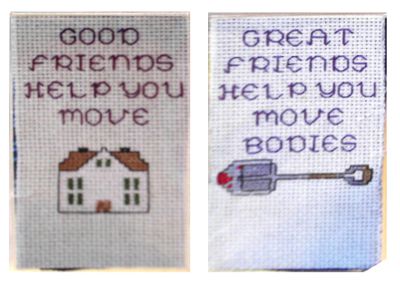

A friend will help you move. A real friend will help you move a body.

“You are also a hoarder,” Liz Arden noted. “You would never throw away the body.”

I do have Quaker roots but I wouldn’t keep it after the stink set in.

I ran into some old friends, the kind who carry shovels in the trunk. One was our flag marshal from my racing days, a man I hadn’t seen for a quarter century. We picked up the conversation we had interrupted at Bridgehampton and haven’t stopped yattering since. I can call Tom an old friend because he is so much older than I. Likewise, one of my college roommates shanghaied me for our reunion last year. All four of us who shared a fourth-floor, cold water, walk-up in downtown Hoboken were there. I’m not sure we’d really use shovels anymore — digging a hole that size by hand is hard work when there are backhoes around — but there’s no question that I’d trailer in the hoe if any of them called.

Those guys are the exception. Lucky, I am.

“Many adults find it hard to develop new friendships or keep up existing friendships,” says the Mayo Clinic. “Friendships may take a back seat to other priorities, such as work or caring for children or aging parents. You and your friends may have grown apart due to changes in your lives or interests. Or maybe you’ve moved to a new community and haven’t yet found a way to meet people. Developing and maintaining good friendships takes effort.”

Friendship takes work.

The teacup story is a far better tale than the broken glass because the teacup has pathos averted, a lesson in maintenance, and a very bright future.

My friend Rufus and I live 400 miles apart. Tom is 1,200 miles away. Gekko and I average 2,000 miles. That means we don’t go to many ball games together; we haven’t worked side by side under the hood of a car for years. We remain besties not only because we have a bond but also because we work at it with cards and calls, email and Skype, and occasional visits. With or without the excavator.

Still, it would be nice to be physically closer. I’ll keep looking.

“It’s never too late to build new friendships or reconnect with old friends,” the Mayo Clinic reminds us. “Investing time in … strengthening your friendships can pay off in better health and a brighter outlook for years to come.”

Exactly. It’s more important to keep the teacup from breaking than to expect to see the broken shards on the floor.


A friend may well be reckoned a masterpiece of nature.
-Ralph Waldo Emerson

It’s more satisfying to dig a ditch with friends
than to design a skyscraper with a team of sociopaths.
A good friend will come and bail you out of jail
A really good friend will be sitting next to you saying,
“Damn…that was fun!”

Jerry said we don’t tend to the friendships in our lives
I’ve spent perhaps most of my adult life talking to strangers
Why don’t people take more time to talk to the ones we love?
–Alan Shore
A man’s never so rich as he is with friendship.
-Denny Crane

Keep only cheerful friends.
The grouches pull you down.
In the End, we will remember not the words of our enemies,
but the silence of our friends.
–Martin Luther King Jr.



Naked Drunk Guy Steals Bobcat

Congress is in recess so I had to go elsewhere for the weird news of the day.

Naked Drunk Guy Steals Bobcat“Naked drunk guy steals bobcat” conjures up thoughts of animal abuse at the zoo. Or worse.


My friend Roland Riviere has lived all his life in Vermont’s Northeast Kingdom. National Geographic magazine chose the Kingdom as one of the top U.S. travel destinations, partly for the rugged scenery and partly for the chance to see a wily catamount.

The cougar (Puma concolor), also known as the mountain lion, puma, panther, or catamount, is a large cat native to the Americas. Vermont is catamount country and the predator cat is a popular name in Vermont. We have Catamount trails, Catamount beer, Catamount Health, and more, but the catamount itself is officially extinct. The U.S. Fish and Wildlife Department says the population most likely vanished in the 1930s.

Still, people regularly claim to see the big cat on the prowl. The Vermont Fish & Wildlife Department investigates about 50 sightings a year.

Roland didn’t have much to do last weekend so he spent a little too much time in the State Fair beer tent. The longer he spent there, the better starting a catamount breeding program sounded. Even better, one of his drinking buddies reported seeing scat and paw prints just north of Lac Wallace in Quebec. Late Saturday night, Roland loaded up his Hav-A-Heart trap and crossed the border into Canada. His GPS took him straight to the buddy’s camp.

The Lord watches over drunks and small children. He baited his trap with a cold Big Mac he found under the truck seat and settled in with a six-pack. A couple of hours later, a screech from the trap woke him. He saw an unhappy, 35 pound cat.

Catamounts are big: 5 – 6 feet long, heavily furred, and weigh 75 – 180 pounds. Bobcats are just 2 – 3 feet long and weigh only 10 – 40 pounds.

“I thought it was a cub,” Roland told the Customs officer who caught him.

Here’s the real story.

“Drunks make for awful drivers and worse thieves. They’re pretty good at dumb excuses, though.

“A 19-year-old Tennessee man was arrested Sunday and charged with felony theft and a short list of misdemeanors after he allegedly got drunk and stole a Bobcat front-loading utility vehicle from a Knoxville-area nursery.” He was just trying to hide his nudity, he said.

I like Roland’s story better.

Of course, the Knoxville News Sentinel, quoting the arrest warrant, reported the loader theft was all a case of criminal cover-up.


Jail – the Liberal Paradise?

My friend Nola “Fanny” Guay is ticked off this morning. Someone sent her this poster by email:

Jail - The Liberal Paradise

“I hate it when people send stuff like this around that just isn’t true,” she said.

Me, too.

Especially when the truth is worse.

No liberal really wants to put the rest of us in jail. Not really. Not even the farthest green protester whose mantra is that the Earth would be sooooo much better without humans.

The poster should read,

Projects — The Liberal Paradise.
A little history of public housing in the United States: The first “model tenements” begin to appear in the Cobble Hill neighborhood of Brooklyn in the 1870s. Alfred Tredway White, a great believer in progressive reform efforts, built a series of buildings for the people known in the nineteenth century as the “deserving poor.”

The working poor, those hardworking people who couldn’t make enough to live in the nineteenth century were called the deserving poor.

Those first public housing residents were carefully screened. Only employed families with two parents were allowed. Alcoholics and those with social problems were banned.

There were other similar efforts but Franklin Delano Roosevelt introduced the first permanent, federally funded housing in the United States. His 1933 New Deal program, the National Industrial Recovery Act, directed the Public Works Administration to undertake the “construction, reconstruction, alteration, or repair under public regulation or control of low-cost housing and slum-clearance projects…” Liberal program.

Harry Truman’s Fair Deal dramatically expanded the role of the federal government in public and private housing with the Housing Act of 1949. Liberal program.

All the discontent with “Urban Renewal” led to Lyndon Johnson’s Housing and Urban Development Act of 1965. Liberal program.

Over those years the rules morphed from allowing only employed families and banning addicts to, in many cases, banning employed families and recruiting addicts. Poor, but maybe not so deserving. Still, the ways of keeping the poor, poor, do match the liberal mantra:

  • Each resident is exactly the same as everyone else.
  • Meals are provided free, along with exercise equipment, library services, television, and more.
  • Free healthcare is to be available on site.
  • Weapons are forbidden even for self-defense.

Now that I’ve done my Liberal pounding for the day, it is worth noting that the Conservative Banker approach to public housing is simpler: “indenture ’em with a mortgage.”


Join us next week when we wonder why under Obamacare (“Free healthcare is to be available to everyone”), a Key West family with insurance received two denial letters this past week for their 2-year old son’s Lymphoma treatment.