
I Told You So.

But did anybody listen? Nooooooooooooooooo.

And so it begins: Vermont Governor Peter Shumlin has proposed a budget for the new year. Gov. Shumlin is a “Big-D” Demorat but one who won’t raise taxes. Gov. Shumlin’s budget increases the provider tax on Vermont’s hospitals by $17.4 million.

A “provider tax” ain’t a real tax, right?

The gov says this increase will simply “maximize the draw down” of matching Federal Medicaid dollars to help fill the State’s budget shortfall. It will tax hospitals, physicians, Home Health Agencies, and pretty much any other healthcare providers. Probably even WalMart because they (used to be able to) sell prescriptions for $4 which makes them a provider.

“Hey, Dick! I get my scrips from Wally now,” Raul Garcia told me. “Did you know that some of the stores charge me sales tax on them some of the time. Some don’t.” Mr. Garcia is North Puffin’s best known hypochondriac and was our most respected grant writer until that little trouble with the Feds. He ended up serving 18 months of a four year sentence for fraud after he used the $4 million he “borrowed” from a major pharmaceutical company as the matching funds for an $8 million corporate gene splicing study at North Puffin College of Veterinary Medicine. The Pharma got their “investment” back when the grant came in. It wasn’t the first time. Even so, he says he has not yet determined which phase of the Moon determines the sales tax boondoggle.

Back on point. Northwestern Medical Center is a small, friendly, not-for-profit, hospital in St. Albans, Vermont. In the interest of full disclosure, I served on the Board of Incorporators for NMC for more than a decade. This regional, primary care facility offers a broad range of high-tech medical equipment and services to the area.

For that one local hospital’s privately insured patients, the added tax means sharing an increase of $350,000 in tax expense alone in the coming year. Yeppers, ObamaCare is gonna reduce the cost of medicine.

And Gov. Shumlin is right at the forefront of that reduction. Newspeak. Word.

No small town hospital is more vital to the community and none is better liked. NMC has earned national Avatar awards for the last three years for patient satisfaction but that’s just part of the story. They sponsor local events like the ArTrain and the Summer Sounds concert series. They field teams for the United Way. And 600 of our friends and neighbors work there.

The original St. Albans Hospital was built in 1883. It has grown and morphed from two hospitals into one that now cares for 1,900 inpatients each year. The E.R. sees over 28,000 emergency patients and 7,000 people already walk in to the new Walk-In Clinic in Georgia each year. 400 babies arrive via storks at the Family Birth Center. That all adds up to more than $129 million of patient care each year.

Gov. Shumlin “proposes to increase the tax assessed on hospitals by $17.4 million from 2011. This increase will be used to draw down Federal funds to help address the State budget shortfall,” NMC Chief Executive Officer Jill Bowen told the St. Albans Messenger. “However, the State no longer returns the provider tax to the hospitals in full after it has secured the matching funds.”

In case you missed it, the State of Vermont told the Feds they took in beaucoup bucks as matching funds to increase the “grant” money funneled back to the state. Then the State of Vermont gave most of those beaucoup bucks back to the hospitals.

“Hey, Dick?” Raoul Garcia said. “Isn’t that what I went to jail for?”
Counting Toes

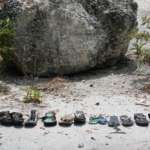
Famous Footwear of the KeysSuppose you have seven shoes lined up in front of your rock. Anne gives you four of my shoes because she is tired of tripping over them. How far south is your rock?

World Math Day is tomorrow. Cool.

The Guinness record holding online international mathematics competition had 1,204,766 participants in 56,082 schools in 235 countries last year. The original World Math Day was held on the March 14 (Pi Day) but has moved to the first Wednesday in March except it is on Tuesday this year. No wonder math is so confusing.

Students from across the world have 48 hours to compete in 20 games in each of five levels. (Quick! How many games is that?) Students have only 60 seconds to complete each game. (Quick! How many minutes do half the games take?)

Those 1.2 million students correctly answered 479,732,613 questions in the 2010 challenge. That broke the record of 452,682,682 correct answers that 1.9 million students had posted in 2009.

I’m thinking you need to know math just to keep track of the answers. And the contestants. In fact, I’m thinking you need a computer. After all, World Math Day would not be possible without computers and the Internet to pair off more than a million competitors and track their results in real time.

The abacus, built by Egyptian mathematicians in 2000 BC, was in widespread use centuries before we even started writing numbers down, let alone before we started formally counting by tens. Merchants, traders and clerks in Africa, Asia, and around the world still use it.

Most people think the Abacus was the first arithmetic calculator. That would be wrong. The first arithmetic calculator was a pile of rocks.

Og have 11 rocks. Og give four rocks to Nug. Og have seven rocks left.

And so we learned very early to make change.

Time passed. Math needs multiplied. Edmund Gunter invented the slide rule around 1620 so engineers could figure out how much a church roof rafter would bend. The slide rule can be faster at multiplication and division, and often is faster for roots, logarithms and trigonometry than a calculator, but it doesn’t add or subtract very easily which makes it not nearly as useful as an abacus as tax time draws near. I was in the last class at Stevens Institute required to buy a slide rule.

Blaise Pascal invented the first mechanical calculator about 20 years after Gunter made his slipstick but IBM waited until 1954 to demonstrate the first all-transistor model. Their first commercial unit, the IBM 608, cost about $80,000.

Scott Flansburg serves as the Ambassador for World Maths Day and is known as “the human calculator” because he can run the numbers faster than an electronic calculator can. Mr. Flansburg visited All Angels Academy students in Miami Springs a couple of weeks ago. He was there to energize students as they prepare for the contest. This is the second year students from the school will participate in this event.

That’s encouraging.

Kids need to be better at math than I am. After all, there are more numbers now.

I have an undergrad degree in math and science as well as one in mechanical engineering but in real life I combine pursuits like this — writing and photography — with consulting to other small businesses. I don’t engineer stuff every day but I do use math. Every day. I use it to calculate my change at Wally World faster than the cash register. I use it to determine how many network cables I need to set up a client’s new computer system. And the programmers I hire used it to make sure these words I type appear on my screen and, shortly, on yours. Every kid today will use more math in his or her lifetime than you or I have.

For the record, I still have my slide rule. I also have a solar powered Casio full scientific calculator, a lot smaller than their first all-electric “compact” calculator of 1957. My handheld cost $10.

Both my slide rule and my solar calculator require light to work. Mr. Flansburg can work in the dark.

Tomorrow is also Town Meeting Day in most of Vermont. Anne who is a Justice of the Peace (and election official) will be counting shoes (and noses) again. I hope she won’t be counting in the dark.

Premte Peeves

Darn!

A good friend has spent the last few days rooting her brand new smart phone; she bought it because she couldn’t upgrade her last one enough. Another friend traded in his perfectly good, 2009 sports car because “he couldn’t do any more with the old one.” I wore a hole in my sock this morning; I tossed it.

We don’t darn socks anymore.

Press 1 for …

Since I speak a creole originally from an island nation, I have an angle.

I took French in grades 7 and 8. My first teacher was Madame Volkenharrrrrrrrrrrrrr who spoke Frahnsh with a combination of rolled Rs and glottal stops. I can still count in French and curse a little but my seventh grade average was a C. I attained Ds the next year.

Sensing a bad trend, I switched to Latin in ninth grade.

That seemed like a wise choice. My mother took four years of Latin. My grandfather and grandmother took four years of Latin. You have to start in grade 9 to fit in four years of Latin. I really really wanted to do that.

My second year French teacher also taught first year Latin.

Uh oh.

Yeppers, I earned Ds in Latin.

Sensing a bad trend, I switched to Spanish in tenth grade.

Aced it. Senora Reagan even called me “Querido Ricardo” in my yearbook. Wrote a nice note there. I think she wished me good luck.

Spanish is a vital language in home life, business, culture and politics in South Puffin and even up north around Miami in the United States. The Miami Herald reports that “one might expect a good report card there when it comes to the quality of the Spanish being spoken.” But the reality that educators and linguists face every day is “an atrocious Spanglish”; they want to clean it up.

I have a better idea. Why don’t the Spanish speakers just learn English?

My friend Nola “Fanny” Guay bridled at that. “There’s no shame in pidgin languages and they help foster a sense of tribal belonging and community among those. It also fosters separateness, which is probably why ‘mericans and educators/linguists want to clean it up. Preferably they’d foster belonging to the fuller community,” she said.

Nope. The paper reported it correctly as Spanglish. Pidgin is a more simplified language that traders construct from pieces of their common languages plus some new words like finiptitude they make up to fill in the gaps. Most people learn a pidgin as a second or third language as they need it. The South Florida Spanglish, on the other hand, incorrectly uses actual Spanish words plus Spanish-sounding English cognates; they end up speaking badly, adopting bad habits from the shared tongue, and trying to keep what-they-think-is-Spanish as the master language.

So why don’t the Spanish speakers just learn good English?

“‘zackly,” Ms. Guay said. “It’s okay to have your own lingo. It’s better to know what the rest of the people around you are speaking, and to communicate with them clearly. Useful, you know.”

Perhaps those educators and linguists feel guilty about English dominance and want to further fragment American society. After all, America grew strong because people could love a country that accepted them and taught them its language and customs.

I called English a creole. Old English grew first as a pidgin as the islands assimilated the Iron Age Picts, Angles and Saxons and Gaels and Danes and Romans. It became a creole language when a generation of English children learned it as their first language and later became a mother tongue in its own right. It is still the most adaptable of languages, free to accept words and rules from other tongues.

And now we have to Press 1 to speak it.

I’m perfectly happy doing business with you in this country if your robotic auto-attend asks me politely to Press 1 for Spanish or French or Moonese. As long as the default selection is English.

Exchange?

Jody Beauregard is a sweet, gentle man who has worked on Tom Ripley’s garbage truck for a decade or so. Before that, he schlepped shingles up ladders for Dean Russell when Dino still had his business in North Puffin.

Providence smiled on Jody three years ago. He scored an indoor job with dental insurance and regular hours. First time he had ever worked 40 hours per week and with a building contractor, so he got to see the “comfortable” end of the construction business.

Until the comfortable got dissed in the meltdown. The contractor laid him off a year later, on his 65th birthday.

Jody didn’t mind too awful bad. He was collecting Unemployment and had enough quarters in to retire. He likes to take off every fall to hunt anyway and expects to put up enough meat to last him through the year then but retirement, ah retirement, would let him feel more relaxed at deer camp.

Or not.

Jody collected about $280/week in UI but he also qualified for $1,286/month net in Social Security. And, of course, he qualified for Medicare. He signed up for Part B. He was in double dipper’s clover. Until Unemployment ran out. And the Unemployment extension ran out. And the extended Unemployment extension ran out.

Early last year, the Great State of Vermont decided to “give” him some medical coverage and to pay his Part B Medicare insurance premium. He was in pig heaven. I’m a pretty fair reporter but I still don’t know how he got on Vermont’s Health Access Plan (VHAP) list or what the requirements are.

It’s an elegant, enchanting, thought-provoking system. In August, September, and October of last year, for example, Social Security charged Jody nothing for his Part B coverage. He was still receiving Unemployment compensation during those months. In November, Social Security deducted the Part B premium from his check. He has received no Unemployment payments that month or since. In December, Vermont paid the Part B premium. In January and February Social Security deducted the Part B premium again but some time last year, he got an unexplained $142 extra deposit from Social Security. Confused yet? I am. The premium Jody pays Vermont has also bounced around, month-by-month, between $15 and $50 per month with no explanation.

A Vermont minion told Jody that the reason the state is not paying his premium anymore is that he “makes too much money.” And yet, his unemployment ended in October and his Social Security check — his only income — is unchanged for the third year in a row. No COLA, doncha know.

They have yet to send statements or bills to him. He has asked for but never received an Explanation of Coverage so he has no idea what the $15 (or $50) he pays each month buys him. Vermont has an sensational online presence but no account Jody can log in to, so he has never known how much the premium for the medical coverage they give him is. “I’m pretty sure it is the Plan B I signed up for plus prescription coverage,” he told me. Sheesh.

The Vermont rep told him he makes too much money but still won’t tell him what poke he gets for his pig.

These are the very people who want to run our car manufacturers (and other businesses) and our statewide health care system.

Gov. Peter Shumlin wants to set up a Health Insurance Exchange. In exchange for what?

“Exchange” as a verb usually means to trade someone one something for a different something else that person has or to replace (perhaps defective) merchandise with its working equivalent. As a noun, we say it is that same something that was given or received as a substitute for something else. Sometimes an exchange is a place, like the Stock Exchange, for buying and selling commodities or securities. That kind of exchange is typically open only to members.

Vermont lawmakers got their first thorough look at the guv’s plans for his beloved single-payer health care system last week. Mr. Shumlin plans to start this year by setting up the same state health insurance exchange the constitutionally-challenged Obamacare calls for.

Mr. Shumlin wants more. His state health insurance exchange will help drive the last commercial insurers out of Vermont and serve as his springboard to moving the state to a single-payer system in micro-steps. This year, he will create a new Vermont Health Reform Board not to control health system costs but rather to dictate how much the state will pay providers for services.

The administration will not unveil its financing plan for the new system until 2013, two years after the system is in place.

Perhaps one year after Mr. Shumlin is no longer in place.

“It’ll be good, Mr. Dick,” Jody Beauregard told me. “I can exchange my plan for something even better.”

Uh huh.

Remember Jody’s experience. Guess who made his life so easy? Happy Valentine’s Day, Jody.