Impressive

Wally World does not often impress me but they did on Friday.

The Internoodle is rife with estimates of Wal-Mart’s cost to We the Overtaxed People, protests over sprawl, criticism of their labor practices in this country and the labor conditions in supplier factories around the globe, complaints about unfair treatment specifically of the women who work in the stores and Supercenters, shoddy assembly of most consumer goods driven by the way the firm has reshaped manufacturing around the world, and far more.

Opponents of a planned Wal-Mart here in North Puffin have protested for almost two decades.

PBS reported, “Wal-Mart’s [Vermont] opponents argue that the state’s economy and culture would be damaged by the retailer’s presence. In California, opponents say the company has cost taxpayers millions by shortchanging its employees on healthcare.”

Every bit of the superstore v. Main Street argument is absolutely true.

Wal-Mart built their fourth Vermont store, a 150,000 square-foot box, in Williston in 1997. I shopped there on Friday.

So did a lot of other people from North Puffin because we don’t have a department store in this county.

We didn’t need any other shopperamas a decade ago because we still had Ames back then but Ames closed all its retail stores here in 2002. Since then, pretty much everyone in Northwestern Vermont has had only a couple of choices for sox and underwear: buy them at the supermarket or the Dollar store or pay the I-89 tax to drive an hour to the big box center in the next county.

So I spent the $27.50 in gas to drive the truck to Williston on Friday because we don’t have a department store any closer than that. I also had to go to the Sears Auto Center but that’s a story I’ll tell later.
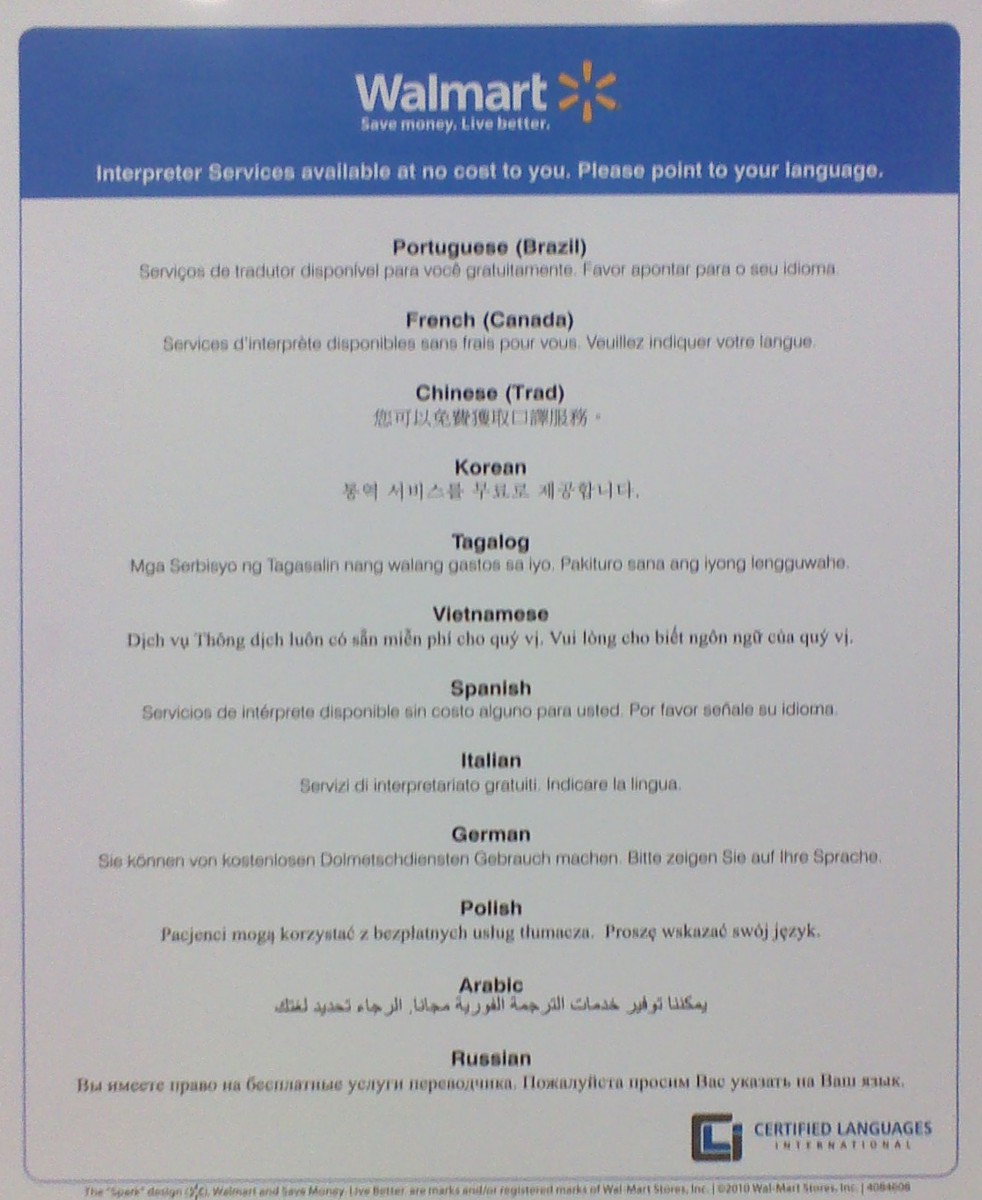
Walmart SignI saw a sign for Wal-Mart Interpreter Services in the pharmacy department. That impressed me and I said so to the pharmacy consultant.

“Surely you don’t have all those interpreters in the store,” I said, “and the tricorder/universal translator isn’t out of Google’s prototype lab yet.”

“Nope,” she told me. “All the customer has to do is point to their language on this card. We call a translator at the home office and Bob’s your uncle.”

The store can handle 12 different languages (13 if you count English) from Arabic to Vietnamese. A mom-and-pop operation can’t afford to keep a dozen U.N. translators on staff.

[Oooo, business opportunity!]

Regular readers know that I will not willingly deal with any company that requires me to “Press 2 for English” in part because immigrants to this great melting pot should help us learn their cultures while they assimilate ours and they need to learn English. Without that, America stops being a melting pot and becomes a nation of tiny, armed, walled, exclusive Arabtowns and Chinatowns and Mexicotowns and Viettowns. That said, Wal-Mart’s system to let them do business in their native tongues means they will do business outside their shell communities and that’s a good thing.

Vote Early, Vote Often

The Media Research Center went to the Supreme Court protests to ask the question, Should Illegal Immigrants Be Allowed to Vote in America?


Cool.

The Right-Thinkers for Electoral Change (the RTEC) have a new engine to reframe the United States Congress. We’re all going to vote against Nancy Pelosi and Harry Reid. And we can do it.

Apparently California’s requirement that “you must be a U.S. citizen; a California resident; at least 18 years of age on Election Day; not in prison or in county jail (serving a state prison sentence or serving a term of more than one year in jail for a defined “low-level” felony), or on parole, post-release community supervision, or post-sentencing probation for a felony conviction; and not judged by a court to be mentally incompetent” to register to vote is only advisory. Nevada offers similar advice.

The California voter registration deadline for the general election must be postmarked no later than October 22, 2012. The last day to request a VBM ballot by mail is October 30. Registered voters may apply for a vote-by-mail ballot for an upcoming election at any time. If you apply by mail, your application must be received no later than 7 days before an election, otherwise you will need to apply in person to get a vote-by-mail ballot for that election.

Rep. Nancy Pelosi was number five of the top 20 liberals, once the highest-ranking female politician in American history, and still the go-to Democrat in Congress according to The Telegraph in 2010. Senate Majority Leader Harry Reid is number nine of the top 20.

If it’s good enough for an undocumented worker, it’s good enough for me.

The general election will be held on Tuesday, November 6, 2012. The RTEC encourages all voters from the right-thinking East Coast of the United States to apply the suggestions set forth by undocumented worker supporters and register to vote in California or Nevada today. Or both.

Can’t You Read the Signs?


Sign, sign, everywhere a sign
Blockin’ out the scenery, breakin’ my mind
Do this, don’t do that, can’t you read the sign?

Facebook bought Instagram for a billion dollars this month (Apple marketing VP Phil Schiller immediately deleted his Instagram account and declared that Instagram had “jumped the shark”). Apple will probably buy Twitter next.Pictograms.

I take a lot of pictures both for the beauty and for the story they tell, but I tell most stories with words. 50,000 a year in newspaper columns. Nearly that many again right here. I could write a book …

That said, I just replaced my cellphone because its camera stopped initializing. When I need a quick note about a concert poster or a reminder of what that unusual car or eccentric person looks like, I prefer to snap a picture and text it to my emailbox. Sometimes I send it to one or two selected friends as well.

A quick and informal survey tells me that more than half the people I know do the same. Voice calls are down. Texting is up but texting with pictures and far fewer words is climbing exponentially.

Grocery fliers have both pictures and text, but the amount of text is dropping.

Gekko and I often Skype™ instead of “just” talking on the VOIP phone; it’s the next best thing to being there. OK, that’s not entirely true but having the (moving) picture is better than not having the (moving) picture to go with our words.

A recent story in the Milwaukee Journal Sentinel highlighted how our communications are changing: “On a cold October night a few years ago, I got out of bed and came downstairs because I realized my cat was still outside. I turned on the porch light, opened the main door, called him and went into the kitchen for a drink of water. When I came back, there was a young man standing in my living room.”

After worrying over the story itself, a cop friend suggested, “Put a Quarantined! Infectious Disease! sign out front.”

Private Property SignHe thinks home invaders can read. (Jeezum, what’s our school system coming to, teaching burglars to read!)

“. . . attached to an explosive charge.”

It’s not the sign that will stop the burglar or home invader. It’s not even the silhouette of a weapon on the sign. It’s the 700 security cameras that take his picture as he walks up the sidewalk, turns up the lane, and steps onto the porch.

The world is progressing back to cuneiform.

Sign, sign, everywhere a sign
Blockin’ out the scenery, breakin’ my mind
Do this, don’t do that, can’t you read the sign?


I carry a 17″ ThinkPad workstation that my friend Liz Arden dubbed the “patio stone” but I do hope the next big Android isn’t a stone tablet.

Everything I Know

Everything I know about history, I learned from Thomas B. Costain.

That would truly annoy Frank Wright, the exceptional high school history teacher from whom I also learned a lot. I tell the Costain story often. It is mostly the truth.

Canadian journalist and editor Thomas B. Costain published his first best-selling historical novel, For My Great Folly, at the age of 57. He had toiled in the writing trenches for most of his working life before Folly. Mr. Costain’s fiction relied so heavily on historic events that one reviewer said “it was hard to tell where history leaves off and apocrypha begins.” Mr. Costain made the story of Joseph of Arimathea and the lowly Basil of Antioch come alive for millions of Americans, including me. The Silver Chalice may have been the first historical novel I ever read.

I had read Chalice, the Tontine, Below the Salt, and the Last Plantagenets before leaving for college. My mom, a Swarthmore alum, also knew American writer James A. Michener and introduced me to his work as well.

Mr. Michener penned some of the best known sagas in literature, novels that spanned the lives of uncounted generations in exotic or previously under reported locales. He was known for his meticulous research which let him work the entire history of each region into his stories. I can almost say I know more about the Chesapeake Bay from reading Mr. Michener’s Chesapeake than from growing on the water there.

The Italian government lauded biographical novelist Irving Stone for the way he highlighted Italian history in the Agony and the Ecstasy, the life of Michelangelo Buonarroti.

So.

How do we separate fact from fiction when our favorite novelists leaven their rising stories with actual history in search of a truth? Or in search of a good story?

It is hard, after reading Costain, not to mistake the Grail story as truth. It is hard, after reading Michener, not to mistake the many generations of the Buk, Bukowski, and Lubonski families as real.

Fast forward.

Jon Stewart is a brilliant satirist. Pew Research Center’s search for the most admired American journalist has Mr. Stewart, the fake news anchor, at Number 4, tied with actual news anchors Brian Williams and Tom Brokaw of NBC, Dan Rather of CBS, and Anderson Cooper of CNN. Dan Rather? OK, it was a 2007 poll. The Daily Show does have pieces of substantive news but satire can’t handle the whole truth and Mr. Stewart has repeatedly insisted that he is only a comedian on a fake news show.

Monologist Mike Daisey played the Lane Series at the Flynn Theater in Burlington, Vermont, this weekend. His The Agony and the Ecstasy of Steve Jobs has caused a national foofah over what is and what isn’t true in his monologue about Apple and its manufacturing practices in China. In January, NPR’s This American Life and its host, Ira Glass, published a critical 39-minute story that detailed the appalling Chinese iPhone plants, a program adapted from Mr. Daisey’s theatrical monologue.

Last weekend, Mr. Glass retracted the story.

The most admired reporter of our times, Edward R. Murrow said, “To be persuasive we must be believable; to be believable we must be credible; to be credible we must be truthful.” From Costain to Michener to Stewart to Daisey to Survivor we’re blurring the line between truth and fiction.

We in the news business must be truthful. But most of all, we must remember that entertainment has no such need.

“Get the facts, Dick,” Frank Wright would tell me. “It’s not the truth without the facts.”

Of course, I’m not sure Mr. Wright ever watched “reality TV.”

Pooh Was Not an Early Adopter

I am a Bear of Very Little Brain, and long words bother me.

It is more fun to talk with someone who doesn’t use long, difficult words but rather short, easy words like “What about lunch?”

“An early adopter or lighthouse customer is an early customer of a given company, product, or technology; in politics, fashion, art, and other fields, this person would be referred to as a trendsetter.”

I’m not old enough to have bought RCA’s CT-100, the first production color TV, but I did carry the first battery powered transistor radio to my elementary school so I could be schooled in the proper musical offerings of WFIL.

And speaking of appliances, we were about the last on the block to get a television at all (it was a 19″ black-and-white RCA that my dad bought used for $75 in 1955) and the last to get a microwave oven. I bought that new, but it was by then deeply discounted.

The “early adopter tax” refers to the trend of new products costing more when they first go on sale than later in the product cycle.

I hate to pay taxes. Hate it.

On the other hand, my great-grandfather had the first railroad train in a front yard in Doe Run and we were the first on our block to own a boat.

I’m a gadget guy from a long line of gadget guys but since bright and shiny long words like early adopter never swayed us, we ended up buying what we needed at the time we needed it, rather than the moment it appeared on the market.

I may not have been the first kid to trade my slide rule for a calculator but I was certainly in the top few; that was in the days when a good K&E slip stick cost $29.95 and the nixie-tube, 4-function calculator cost $179.95, about six times that. Of course the calculator could add and subtract, something I have never done effectively on a slide rule.

I never owned an IBM 5150, but I did build a Sinclair ZX80 which I replaced with one of the early Commodore C-64s. I ran my first business on that Commodore computer and might still be using it today had not the spreadsheets gotten too large for storing on a single floppy disk. My friend Rufus has a Betamax somewhere. On the other hand, he gave up his Pulsar watch for a Casio C-801 about 30 seconds after it arrived on the market. He still has a couple of those.

Liz Arden switched briefly from a standalone GPS to the Google™-driven app in her smartfone. She just bought a new GPS because it works better.

Today, I travel with a GPS (see above paragraph), an iPod Touch which I use as my PDA, and a “feature” cellphone. I think that’s all I need for now. Of course, I’ll be on a great silver bird in the sky on Wednesday where I’ll find a Sky Mall in every seat pocket.

Is it time for lunch yet?