To Launder

No, I’m not coming clean with a new “Dear Dick Launders” column.

Launder verb \’lön-der, ‘län-\
1: to wash in water
2: to make ready for use by washing
3: to sanitize

Related words include cleanse, purge, purify; bleep, blip, cut (out), delete, excise, expunge, gut, x (out); black out, repress, silence, suppress; censure, condemn, denounce; examine, review, screen, and scrutinize, none of which have anything to do with this topic.

Seems a lot to do for a towel and washcloth.

Did you ever wonder why you need to wash (launder) a washcloth? Or a dishrag?

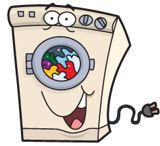
Happy Washing MachineConsider how you use that wash cloth or dish rag. First you submerge it in water to thoroughly wet it. Perhaps simultaneously, you pour on or rub in some soap.

“A soap micelle has a hydrophilic head that is in contact with the water and a center of hydrophobic tails, which can be used to isolate grime.”

Bang the cloth around on bones or dishes for a while. Rinse it out. Maybe lather and repeat. Rinse again. And then wring it dry before hanging it up.

Where have I done that before?

Just exactly what happens when you launder that wash cloth? First you submerge it in water to thoroughly wet it. Perhaps simultaneously, you add soap to the mix. Bang the cloth around on rocks for a while, rinse, and wring dry.

Wait. I did that before you snatched it for the happy washing machine. And yet we need to do it every day?

Really? Every day? Twice?


Next week, we’ll take on towels which spend their entire lives shuttling between mopping up clean water from squeaky bodies and getting beaten on rocks.


Today is Earth Day

I suspect that has nothing to do with the fact that eBay’s President and CEO, John Donahoe, personally emailed me this morning. “Congress is considering online sales tax legislation that is wrongheaded and unfair,” he said, “and I am writing to ask for your help in telling Congress ‘No!’ to new sales taxes and burdens for small businesses.”

I’m all for no new taxes or burdens on small businesses (or their customers).

Voters seem to have a different idea.

Voters haven’t figured out that when they tell the boneheads they elect to “stick it to the rich businessman or rich businesswoman” what they are really doing is making their own cigs or Twinkies or wife-beater t-shirts cost more.

Most states levy a sales and use tax on merchandise.

Here are the arguments, pro and con.

Does the Sales Tax Break the Piggy Bank?PRO: Sales tax proponents say taxing goods bring economic growth, savings, and investment. I’ve seen no reliable data proving that. Still, the rooms and meals tax here in South Florida is about to ratchet up another thousand percent to finance Dolphin Stadium. That’s OK, though, because that tax fleeces only the tourons.

If a sales and use tax on merchandise is legit, then online sellers should charge it the same way local stores do. After all, people who use stuff owe the tax no matter where the stuff is bought.

CON: Sales taxes are regressive. (A regressive tax is defined as “a tax that takes a larger percentage from low-income people than from high-income people.”) I discussed the how much a bigger bite of your paycheck a sales tax takes here last week.

I don’t believe sales and use tax on merchandise is a fair or equitable way for a state to raise funds so no online merchant should collect it; the local stores ought not charge it either.

Mr. Donahoe thinks the solution is simple: if Congress passes online sales tax legislation, eBay says small businesses with [fewer] than 50 employees or less than $10 million in annual out-of-state sales should be exempt from the burden of collecting sales taxes nationwide. Mr. Donahoe wrote “less” there, but I corrected that, too.

eBay’s solution is the worst of all possible worlds. If the tax is due, exempting one group from collecting it is an accounting (and marketing) nightmare, not to mention probably unconstitutional.

And what happens when a $9,999,990 business sells an extra $10 this year? They didn’t collect tax all year. Do they go back to all their customers? Do they suddenly have to find the $5 or $600,000 in taxes owed from their own revenue?

“So what is the fair and equitable way for a state to raise funds?” Liz Arden asked me.

Flat income tax.

If We the Overtaxed people really really understood how much it costs us to employ 22,267,206 federal plus state and local government civilian workers, we would have thrown the always-on-vacation bums out of office decades ago.

And that, dear reader, is why there will never, ever be tax reform in these United States.

(The U.S. Census reports, in a file called “APES,” that our federal government civilian employment plus state and local government public employment payroll for March of 2011 was about $86,500,000,000.)


Did you know you can deduct the state sales tax you pay from your federal tax return?


We the Overtaxed People

At 11:59 p.m. tonight, not 12 hours from now, millions of Americans including Rufus will make their annual mad dash to the post office.


Filing High
I e-filed for the first time this year. Tubbo Tax was a little confused because I didn’t owe any extra and wasn’t due a refund

Familiar icons with Follow us on Facebook and Twitter, IRS logoOddly, Tubbo sent the email announcing that the IRS had accepted my return four minutes before they sent the email announcing that they had successfully sent the IRS my return.

I shouldn’t be worried, right?

This little box came up at the end of the filing status:

How to check your refund status?
Download the MyTaxRefund app and check your status anywhere.
Available on iPhone, iPad, and Android devices.

And then! And THEN!

Filing feels good! Share your tax triumph with your friends.
(Don’t worry, nothing confidential is shared.)
[f Share] [Tweet]

What? Are they nutz?


Taxation WITH Representation
An Internoodle meme going around states incorrectly that Americans paid no taxes before the Income Tax was made permanent in 1913.

The U.S. did impose income taxes during the Civil War and again in the 1890s to pay for war expenses but didn’t make them permanent until 1913. Up until then excise taxes on alcohol and later added to gasoline, tires, telephones, tobacco, and a host of other commodities raised a lot of money to fund the government. Tariffs raised even more. Tariffs were the largest source of federal revenue (and the easiest to collect) from the 1790s until the income tax started growing.

IRS asks, Do you need more time?Tariffs were one of the major causes of the Civil War.
We’ve also had property taxes since colonial times; in fact, the only reason we could go to war against Britain is that we had well-developed tax systems in place to pay for it. By 1796, seven of the then-15 states had poll taxes. 12 taxed some or all livestock. All taxed land one way or another. Most taxed specific occupations.

We the Overtaxed People have been that way since before we threw the (taxable) tea in the harbor.

For the record, I support (a) the flat income tax and (b) elimination of all other tax methods including corporate taxes. People have the right to be taxed fairly, the right to know how much is coming out of their pockets, and the right not to be taxed two or three times on the same income.

Tariffs, excise taxes, sales and value added taxes, and even property taxes are the most regressive way to raise money from a population.

Alabama and Mississippi which have no state minimum wage charge sales tax on food (and they’re not alone). Let’s assume you live in Birmingham in the forward thinking state of Alabama and make $7.50 per hour. You don’t make enough to owe any income tax but we’ll still get you.

Americans report spending $151 on food per week on average but let’s assume you can’t afford to spend half your gross paycheck at the grocery.

If you buy $100/week in Alabama groceries, $8 of that goes to the state. That’s a tax rate of “only 2.66%.” Add in the tax on your phone and cable and apartment and gasoline and it’s easy to see how someone earning minimum wage has a higher actual tax rate than Warren Buffett.


We’re from the Government; We’re Here to Help You Get Healthy
My friend Kay Ace visited the doc a couple of times recently. She was in just before Christmas for a well-grownup, six-month checkup. And she went in last month with that crud going around.

The cost of her office visit went from $93 in December to $113 in March, 100% of which was covered by Medicare. Her Medicare Advantage copay went from $20 to $25. Oh, yeah, and her premium went up.

“Obamacare: We’ll save you money®.”

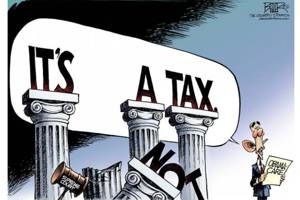
SCOTUS Upholds Obamacare: It's a tax
 

“23 Hours Remaining”

Warning: Tech joke ahead.

“I’ve gotten FAT.”

OK, that’s not exactly true, since I’m on NTFS and haven’t used FAT for years but I do have a lot of files.

I don’t make a living at photography but I do shoot to sell and that means I have what we call in the trade a “lot of shutter actuations.”

Three of my cameras since the 1980s really stand out: a Canon A-1, a Kodak DC-4800, and the new Canon 6D. Two of those are digital and I’ve scanned at least some of the film I shot before the turn of the Century.

That means my hard disk has gotten fat.

Every new photo from the new camera makes a 21MB file.

Some of those older photos are snapshots. Nice memories. Good for the refrigerator door. Not something I’ll put in a frame in the gallery. The rest are artistic or commercial.

I have probably 4,700 snapshots (there are about 10GB in 9,300 files) shot through 2000. The 3,800 images for printing or show from 2001-11 take another 16.7GB on the drive. I’ve never used 96% of those but I mean to.

2,127 shots in the 12 weeks since I bought the new camera, and another 300 keepers (576 files) out of those for 8.3GB. I’m ‘shopping and printing a far higher percentage of the originals than I did with any of the other cameras.

Assuming I might realistically keep 1,000 photos/year and print 200 of them, I’ll need 30 or 35 GB of new file storage each year just for gallery photos. That’s not as bad as I first thought but it’s still a lot to fit on my local drive so I went looking for online storage.

Google charges $0.085/GB/month for the first 0-1 TB which doesn’t sound like much until you multiply it by 12,000. Dropbox has an annual fee of $500 (OK, $499) for ½ TB.

Hmmm. Justcloud.com (something I’d never heard of), Backblaze (ditto) and a couple of others are under $50/year for unlimited storage with file versioning and more stars in reliability than Sugarsync or Carbonite.

Meanwhile, I ordered a 2 TB external drive because I need room for my next shoot. I did that because I still haven’t figured out how to install a non-RAID second drive in the second drive bay on my laptop. I’d RTM if Lenovo would give me one. I spent a while googling for one and nada.

The FedEx guy snuck the new drive onto the porch the very next day.

It’s amazing how 2 TB appears to fit in the same size box that used to hold 2 MB. The Quick Start guide has three pictures: one of de stuff in de box. One showing how to plug the wall wart into the wall and the drive. One showing the USB cable going into the drive and the computer.

I started copying files. Gonna take a long time.


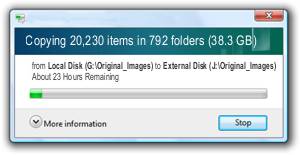
Copying Files - 23 Hours Remaining

Copying 20,230 items in 792 folders (38.3 GB)
from Local Disk (G:\Original_Images) to External Disk (J:\Original_Images)
About 23 Hours Remaining

It turns out 22,163 (56GB) in image files of various descriptions transferred overnight the first night. 2,125 are in the dodged-and-burned-and-ready-to-sell category and the rest are originals.

This is becoming a gallery problem as well. About 180 of my fine art photos have moved over to the gallery.northpuffin.com site so far. I could have ten times that many online by the end of the year and that’s simply too too many for visitors (and buyers) to process.

The new camera can shoot production quality, HD video. I dunno what I’ll do if I start shooting video but I think my new hard drive will disown me.


Scientific Art Show

The Bent-Northrop Memorial Library of Fairfield, Vermont, will debut a three-person statewide art tour on Monday at 6 p.m. after the library has closed. The Brain-to-Brain Art Download Tour has additional stops planned at other libraries around the state.

Three Franklin County artists will participate: musician Jeff Blouin of Neon Spoon, painter and iPhone photographer Paule Gingras of St. Albans, and writer and former CTV Anchor Bill Haugland of Highgate Springs. Each will have a new work available for brain-to-brain download.

The art is in the work. The science — and the show — come from the download.

Brain-to-brain interfaces have arrived for reading, music, or art. Thanks to researchers at UVM, it will soon be commercially possible to download a virtual story from the author’s brain, a painting from an artist, or a song from a musician. Don’t forget to leave an actual cash payment.

Here’s how it works. Multiple electrodes placed on the artist’s scalp record activity from the artist’s cerebral cortex and convert it into an electrical signal that is delivered via neural link to another set of electrodes on an exhibit visitor. The attendee’s brain processes the signal from the artist and — despite being unfamiliar with the work the artist has performed — gains total recall of the piece. And, thanks to a new smartphone app, the artist and viewer will soon be in different locations.

“This is mind-blowing,” UVM neuroscientist Bernard Schwartz said.

Dr. Schwartz and his colleagues built on an experiment led by Duke neuroscientist Miguel Nicolelis, a pioneer in the field of brain-machine interfaces. In that 2008 work, Dr. Nicolelis implanted a monkey with a new brain-computer interface. The monkey controlled a robot walking on a treadmill in Kyoto, Japan. The monkey watched the robot walking in sync with him by way of a display screen.

A new experiment reported this year showed brain to brain communication between rats, one in Natal, Brazil, and one at Duke in North Carolina using similar brain-computer interfaces. In that experiment, the “encoder” rat in Brazil learned to press a lever in its cage. The brain implant recorded activity from the rat’s motor cortex and converted it into an electrical signal delivered via neural link to the brain implant of a second “decoder” rat.

It was a simple step to human artists.

“Artists are in this respect easier to work with,” Dr. Schwartz said. “Because they can visualize an entire work at one time.”

Each artist will download just three times to “mind-melders” in the library gallery.

“Why not have ’em put together a medley of earworm songs!” Bent-Northrop’s Wendy Maquera asked. “I wonder which one would stick?” We went to my Interweb friends to work up a set list that included All the Single Ladies, Call Me Maybe, Jenny (867-5309), Old Time Rock and Roll, Pinball Wizard, Take a Letter, Maria, Tubthumping and Never Gonna Give You Up (with an over-saturated Spoony doing the video dance moves) plus George Thorogood’s Bad to the Bone and I Drink Alone, and a famed horror writer’s suggestion of Bach’s Concerto for Two Violins in D Minor or Tuvan throat-singing.

Mr. Blouin has worked out a new the Gregorian Chant that he “guarantees will plant an earworm.” His rendition of Celine Dion’s My Heart Will Go On includes the score and lyrics.

Ms. Gingras “shares the beauty people walk by and never notice” with her iPhone photos. Her piece for this show blends technology with her Franklin County landscape.

After It Rains, Mr. Haugland’s new book of short stories, is coming out in June. He will spin The Photograph for this show. “I’m intrigued that even a dinosaur with technology can simply think about a picture and put the entire story in someone’s head,” he said, “so I’m game.”

The rat study was published in Scientific Reports in January; Dr. Schwartz plans to publish later this year. Apple and Google have already expressed interest in the technology.

Tickets, schedules, and downloadable background materials are available at ticketmaster.allarts.org. Admission is FREE but you must have an advance reservation to participate. Proceeds will benefit local art projects in Franklin County, Vermont.