Diminishing Expectations

“We’ll insure 30 million Americans who don’t have insurance,” Barack Obama said in 2008.

“We’ll insure 27 million Americans,” Barack Obama said in 2009.

“We’ll insure 15 million Americans by 2013,” Barack Obama said in 2011.

“We’ll insure 7 million Americans by March of next year,” Barack Obama said when he moved the deadline in 2013. Again

“We’ll insure 6 million Americans by March 31,” the White House said in last week.

“We’ll insure 2.8 million Americans by 2016,” the White House will say in July.

According to the U.S. Census Bureau, 48.6 million Americans had no health insurance in 2009, 50% more than Mr. Obama originally promised Obamacare would originally cover. “There are still more people uninsured today than when Obama was elected president,” U.S. Rep. Jack Kingston (R-GA) said recently.

He’s mostly right. 15.4% of Americans were uninsured during the first quarter of 2009. That’s 47.7 million folks. 15.9 percent of Americans are uninsured today. That’s 49.9 million folks.

The Obama administration’s original goal was to enroll 30 million 15 million 7 million^H^H^H 6 million people by the end of the open enrollment period on March 31. Around 20% of those will fail to pay and most of those who do follow through already had had insurance that Mr. Obama cancelled.

That’s today.

Do you have insurance? Today is your last day to sign up.

Do you have insurance today?

45.1 million Americans won’t.


And the hidden gotcha: your premium in 2015 will be significantly higher than those in 2014. Aetna and WellPoint predict that most carriers will raise rates by “double digits.”  So will your taxes.


BREAKING NEWS: healthcare.gov was down again for much of March 31 under the crush of the tens of people trying to sign up at the last minute.


How Hard Is It?

How hard is it to get a cow to back up? I asked Rufus.

“They’ll do it,” he said. “But they don’t like it.”

The question came up when I was out for my morning walk. One of my neighbors was walking her dog. The dog got into a corner and couldn’t get out. The. Dog. Would. Not. Back. Up.

That’s obviously a problem in search of a modern solution.

Most modern cars have MP3 players, in-dash GPS, and rear view cameras on the option or standard equipment list. I was in a Ford recently. The Ford SYNC system is a “factory-installed, integrated in-vehicle communications and entertainment system that allows users to make hands-free telephone calls, control music and perform other functions with the use of voice commands.” Ford and other third-party developers developed a laundry list of applications and user interfaces that include a pretty slick backup camera. The SYNC (Powered by Microsoft™) in that particular car required rebooting the car every now and then and the radio never did the same thing twice but that’s another story.

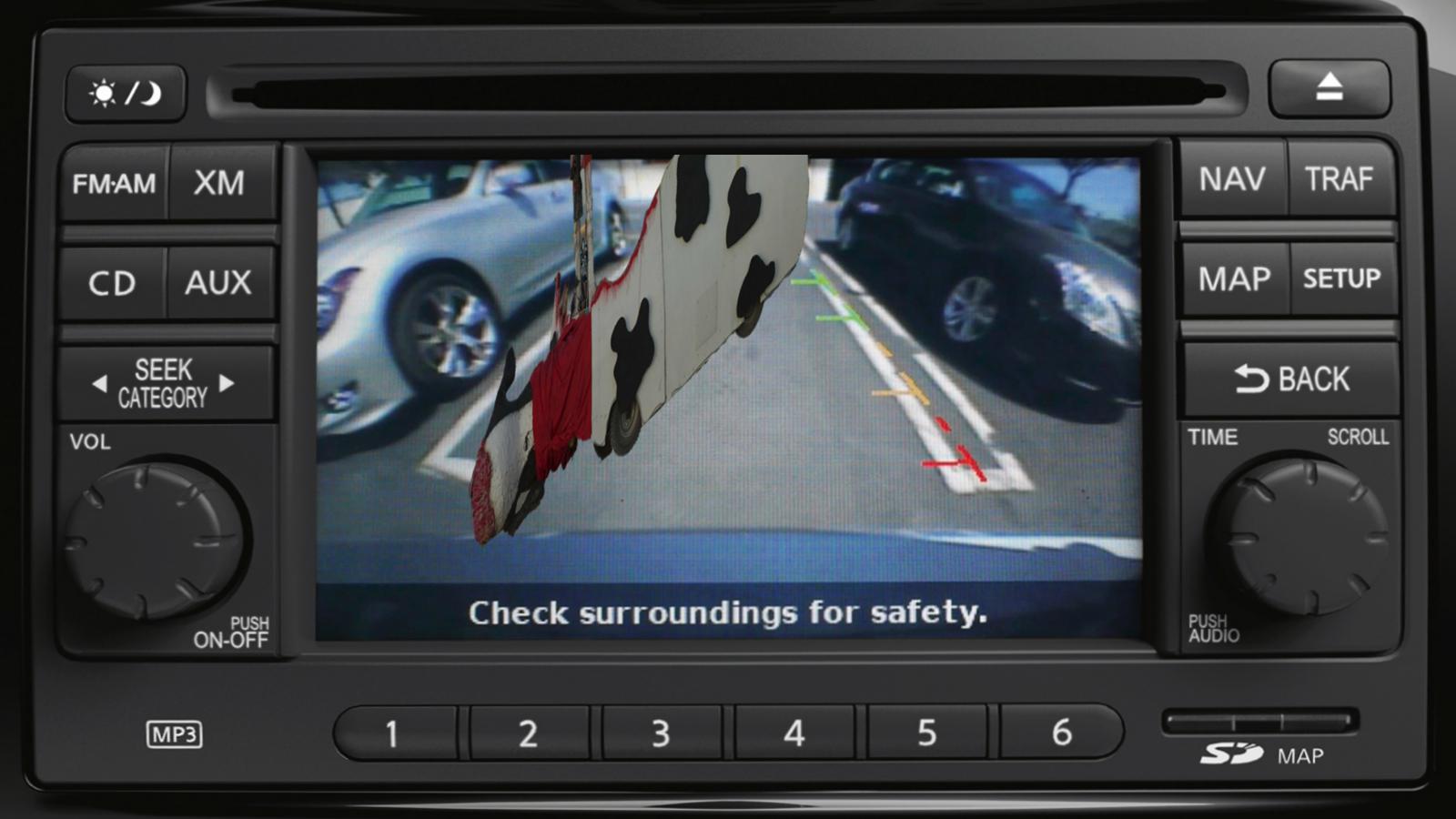
Dead Cow in the Backup CameraThe backup camera assists drivers in several ways. It can eliminate blind spots like the one right under your bumper and, if it operates while your car is in drive, you can see more about the cars around you on the freeway which means that airhead who cut you off this morning could have actually looked before changing lanes. It may swivel so you can see to parallel park. And it’s invaluable in big pickups, motor homes, and camping trailers.

I had occasion to back a pickup onto the boat trailer alone the other day. No need to figure out those conflicting hand signals Rufus was giving me. I just swivelled the eye down a little so I could bring the ball right in under the coupler.

If your car doesn’t have one already, you can add it.

Liz Arden is doing that now.

She already has a radio with the big LED display screen and an auxiliary input for a camera, so wiring one from the license plate bracket to the dash is a (relative) breeze.

She bought the camera with the widest viewing angle she could get. It’s high resolution and sharp. She hopes it is weather resistant.

I propose we mount backup cameras on dogs and horses because they obviously don’t like going where they can’t see. Cows are on their own. Further, it should be a government program. After all, Sen. Tom Coburn found that we spent $175,587 to study the connections between cocaine and risky sex habits of quail.


Puttering

I hate to reinvent the wheel.

(As an aside, that probably explains why I don’t like to drive the same road back that I take to the store, but that’s a whole ‘nother kettle of fish.)
Roller ChainLiz Arden and I were discussing using off-the-shelf widgets in product design. We mostly do that all the time. A conveyor builder, for example, would no more design a proprietary chain or sprocket for the electric motor than build a fiberglass cow to straddle the conveyor belt in a book factory. See, someone else has already invented the roller chain and you can buy as much as you want at any industrial hardware store.

This story is about websites.

I mentioned this preference for off-the-shelf stuff because I’ve been jinkering with the North Puffin Gallery. That’s my site over here that acts as a portal to my mom’s paintings and scratchboards, my own portfolio of interesting work that may be for exhibit only, and the emporium where I try to separate art afficionados from their moolah.

Lazy I am. I like slideshow gallery presentations but I hadn’t bothered changing from my static display, mostly because I really didn’t feel like reinventing the wheel. Or writing the code.

There are 29,763 freely downloadable slideshows available online.

Lazy I am. I like slideshow gallery presentations but I hadn’t bothered changing from my static display, mostly because I really didn’t feel like wading through all that code.

OK, I started wading.

First things first. The design parameters.

Any slideshow must “fit” the other pages on the site.
The “slides” had to be easy to update as the exhibit changes.
Slides should link to descriptive (or sales) pages.
The show should have navigation buttons.
The page cannot use Flash™.
The code had to be open source and easy to change.

The original source code of “open source software” is freely available and the owner allows all users to use, redistribute, and modify it.

Flash™ is common on sites but (fortunately) many designers are moving away from it in applications like this. It is sloooooooooooooow loading. The back buttons are difficult (or impossible) to make work. Basic text functions like copy-and-paste don’t work. Adobe doesn’t even use it on their own site. And it doesn’t scale well to mobile devices. I decided right from the start to use standard HTML and Java coding.

I found a bunch that fit my list.
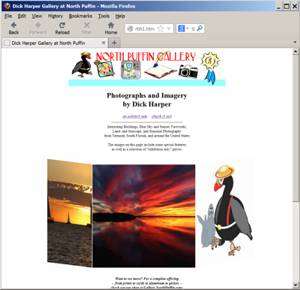
Sample Page No. 1This is Ger Versluis’ Carousel, a page that has that displays multiple images in a 3D, carousel style. It has a number of lovely tricks for code that was written a decade ago. The slides slide in from either right to left, or left to right. I can set it to have pretty much as many images in view as I want (I chose three for this sample). Each image can have its own associated link. The carousel pauses on mouseover. And the script works in all browsers introduced since about 2001. Cool.

But it doesn’t have a way to title the images and there are no navigation buttons.
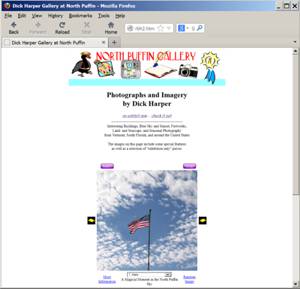
 

Sample Page No. 2Patrick Fitzgerald developed this script about the same time Mr. Versluis released the carousel. It doesn’t have the multiple images sliding around that we see on other pages but I made my own custom Start and Pause buttons, and moved the other links to match my page layout. The best part for me is the dropbox that lets you go to any slide in the show and then restart the flow from there.
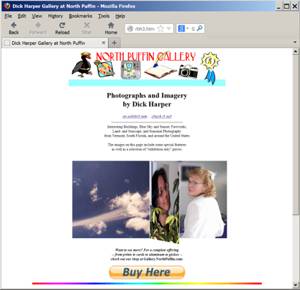
 

Sample Page No. 3Book Flip is another image slideshow from Mr. Versluis. This time he simulates a page being turned to reveal two new slides at once. It is indeed an impressive display. I set it to flip horizontally because our browsers and monitors mostly display in landscape but it can work vertically. Each image can have its own associated link. The carousel pauses on mouseover. And the script works in all browsers introduced since about 2001. Cool.

But it still doesn’t have a way to title the images and there are no navigation buttons.

I like the carousel in number 1 and the book feel of number three but I love the controls and added text in number two.

Blog Contest:
OK, OK, it’s really a survey. I really want to know which of the three slide shows you like better. Click one of these links to drop me a quick email to let me know or leave a comment below.

Sample #1         Sample #2        Sample #3
Something Else
A winner (chosen from among all the entries) will receive a free lifetime subscription to the No Puffin Perspective™1!

And if you want to look at the code to tell me how to add the buttons to Number 1 or Number 3, that’d be great!

Next up, why the remote control for your TV doesn’t speak to your BluRay player.


1“Lifetime” in this case means the life of the world, the Internet, or this online column, whichever ends first.


I Hate Lines

I hate liars more.

!@#$%& KMart had peanuts on sale and I needed a clothes line. The peanut aisle was, of course, empty of peanuts and had no “sale” stickers on the shelves so I went to the front counter to grab a flier, just to make sure I was right.

I was.

A slight aside: This event occurred at the Marathon, Florida, KMart. This store, perhaps the least liked of all KMart locations, has long been said to be the most profitable per square foot of all that chain’s retail locations. Local customers dislike the store because they regularly run out of sale merchandise. Local customers dislike the store because many of the staff are surly or missing. Local customers dislike the store because the one or two open checkout lines are always backed up and slow. A typical Yelp review of this location was “now I know why KMart is struggling and closing stores.” It does have a decent fishing section. There were no peanuts there, either.

Since I was at the customer service counter and there was no line, I asked for a rain check.

“What’s a rain check?” the customer service employee asked.

After I dope slapped myself to make sure I heard correctly, I explained.

“This term comes from baseball, where in the 1880s it became the practice to offer paying spectators a rain check entitling them to future admission for a game that was postponed or ended early owing to bad weather. By the early 1900s the term was transferred to tickets for other kinds of entertainment, and later to a coupon entitling a customer to buy, at a later date and at the same price, a sale item temporarily out of stock.”

“Oh, we don’t give those.”

“Of course you do. Every KMart in the country does.”

“No we never have.”

We never have?

Welcome to the MyKmart Community!
Rain checks are normally offered as a final solution after all other options have been completed in locating your item. Rain checks do not apply to special purchases, clearance and closeout sales where quantities are advertised as being limited.
Normally once a rain check is filled out, you will be called once the merchandise comes in and have a specific amount of days to come in and pick up your items, otherwise they will be placed back on the shelf.

Another employee was there. He said they did and to call Mr. So-and-So.

“No, we don’t do that.” The other fellow faded. I guess he saw the look on my face. I hate to be lied to.

A third rocket scientist came up.

“Oh, we have never given rain checks,” she said.

That’s when I returned my cart to her.


Rain checks are a good news/bad news solution for a retail store. Every business wants to minimize inventory and maximize inventory turns. If you hold too much inventory, whether on the shelf or in the warehouse, you risk getting stuck with stuff you can’t sell. If you hold too little inventory, then you risk running out and losing customer good will. Either problem costs you money.

KMart apparently worries not about losing customer good will.

Were I a KMart employee, particularly one charged with maintaining inventory, I might not want to give a customer a rain check either. See, their 1940s policy to bring in the oversold/sold out merchandise, store it in the layaway center, and then stand around in the layaway center back there in the far dungeon of the store waiting for the customer, I’m sure I’d find something better to do with my time.

Still, were I a KMart employee, I wouldn’t lie about it to the customer.

!@#$%& Kmart. I never did get my clothesline.


How Much Will the Government Give You?

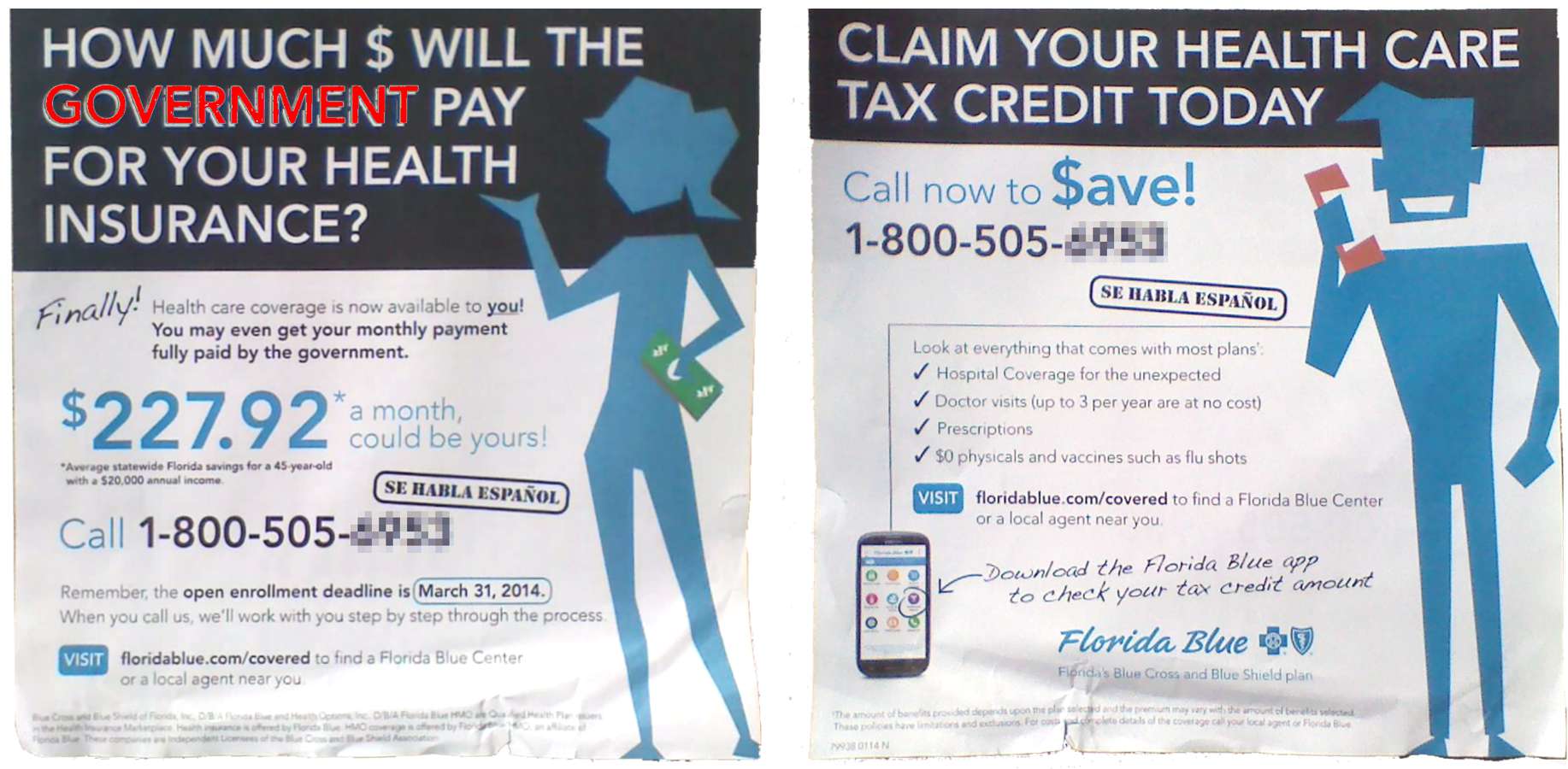
How Much Will the Government Give YouBlue Cross blew an advertising flier into the Herald yesterday to remind us that the open enrollment deadline is just 28 days away.

Want to know why Obamacare can’t flourish over the long run? Click through to see the slightly crumpled flier. I’ll wait.

“A democracy cannot exist as a permanent form of government. It can only exist until the majority discovers it can vote itself largess out of the public treasury…”

This quote probably originated in Elmer T. Peterson’s 1951 op-ed piece in The Daily Oklahoman. Mr. Peterson had probably read Democracy in America.

“The American Republic will endure until the day Congress discovers that it can bribe the public with the public’s money.”

Alexis-Charles-Henri Clerel de Tocqueville was a French political historian best known for the two-volume Democracy in America and for The Old Regime and the Revolution.

In 2000, the health policy journal Health Affairs found that the United States spends “substantially more on health care” than any other country. The use of health care services in the U.S. is below the Organisation for Economic Co-operation and Development median by most measures. The study also concluded that the 19 next most wealthy countries by GDP each pay less than half what the U.S. does for health care.

The Centers for Medicare and Medicaid Services reports that in 2012 U.S. health care spending increased 3.7% to $2.8 trillion, or $8,915 per person. 3.7% is “slowest growth rate on record.” That sounds like welcome news until you look at the real numbers:
1. The official Cost of Living increase is less than half that.
2. Total annual health care spending at this “slow growth rate” will double in less than 20 years, to $17,830 per person.

HOW MUCH $ WILL THE GOVERNMENT
PAY FOR YOUR HEALTH INSURANCE?

And where does “the government” get the money?

The Congressional Budget office estimates that Federal spending on major health care programs will rise from $2.8 trillion in 2012 to $23.8 trillion in 2038. “A trillion here a trillion there and pretty soon you’re talking real money.”

And where does “the government” get the money?

We can’t blame Blue Cross for this; in fact, we ought to thank them for the reminder.

And where does “the government” get the money?

See, the final vote tally for the Obamacare “reform legislation” was 60 Senators plus 219 Representatives. 34 Demorats in the House joined all Regublicans in both houses in opposition. Want to see who would bribe the public with the public’s money? Here’s the blacklist.

Mr. Peterson concluded:

After that, the majority always votes for the candidate promising the most benefits with the result the democracy collapses because of the loose fiscal policy ensuing, always to be followed by a dictatorship, then a monarchy.

Horse thievery used to was a hanging offense.


Steven Brill wrote in Time Magazine, “Put simply, with Obamacare we’ve changed the rules related to who pays for what, but we haven’t done much to change the prices we pay.”