
Bell’s Blues

Google denied selling out network neutrality with Verizon earlier this month but the ballistic blogosphere bucked that.

You may recall that Google and Verizon unveiled a plan on August 9 that would prohibit wireline operators from discriminating on the open Internet but proposed a second, closed (mobile) Internet where they could do just that.

Turns out that BP’s Tony Hayward has assumed the helm of the joint GOOG-VZ P.R. department.

[Important Note: The following column appeared under this same title in the Burlington Free Press in March of 1997.]

“Hang on. I dropped the phone.”

Like the toilet, the telephone is the household appliance that must perform faithfully every time you need to make a call.

Once upon a time the telephone came one style (Durable Dial), one color (Bell Black). One monopoly served everyone. Local calls were unlimited, operators assisted, phone bills were reasonable, and the phones stood up to the occasional gambol on the kitchen floor.

Then, with a swipe of the judicial pen, “Ma Bell” split into AT&T and all the regional Baby Bells like New England Bell. Phone bills soared. We all had to buy cheap phones that bounce poorly. Trust in the phone company went down the toilet.

Heard at a Vermont IGA, “Their minutes last 53 seconds.”

[Historical Note: New England Bell spawned NYNEX which in turn merged with Bell Atlantic and spawned Verizon which sold out to Fairpoint which went bankrupt. See how that works?]

Thanks to the Vermont Telecommunications Agreement, NYNEX gave us measured service. In phone company parlance, measured service counts each instant of local phone use. Then they bill us. NYNEX sold measured service to Vermonters by saying it controls our local telephone costs.

Sure. The old way, we paid $19.63 every month.

Measured service means we can’t “pay any more that $26.67.” If you manage not to use their minimum daily allowance, you’ll pay only $19.52.

Here’s the scoop. NYNEX “gives” us a $6.95 worth of message units each month. Every message unit amounts to one minute on the phone. More or less. When you use more message units, NYNEX bills you. NYNEX charges you for each whole minute’s worth if you use even a single second. Even if you get a wrong number. If I use less than my allotment, does NYNEX give me a discount? No. They just make more profit.

Who counts those minutes? The electric company puts their meters where we can see them. When I pump gasoline into my car, the readout tells me how much in thousandths of gallons. I’ve always wondered why I need that kind of precision.

I installed a phone timer to record every outgoing call; the log shows whether the call is peak or off-peak. The local usage charge on my bill has never come within 10% of the total shown in the log. Since NYNEX apparently cannot count, I guess I do need the gas pump kind of precision in my phone bill. Wasn’t NYNEX forced to return a $15 million excess profit?

Maybe that’s why they needed an 8.2% rate increase [then].

Measured service is such a delicious oxymoron. It positions its purveyors perfectly in a world where decamping lovers practice “cruel kindness,” a computer crash can cause a “partial shutdown” in your life, and “call answering” leads to a heartfelt conversation with a computer voice.

Almost everyone has a phone story. Your state Public Service Board wants to hear yours. Speak up at public hearings; write to them in your state capitol. If one or two of us sing loud and long, it might sound like a song from Woodstock. If a hundred of us serenade them, they’ll think it’s a movement. And if they get letters by the mailbag, who knows, NYNEX might get some competition. With more than one dial tone provider looking for your business, Vermonters might get nicer phone bills.

There is another way. A NYNEX representative told me she has had measured service for a few years, and it doesn’t cost her any extra.

“How so?” I asked.

“I don’t make any calls.”

Back to Verizon and Google. The Internet will be open but not the mobile Internet.

The big players say it is to protect bandwidth.

Some of the talking heads agree and note it is to protect (phone company) revenue.

The Media and Democracy Coalition, for example, noted that this have-have not system “could further widen the digital divide, particularly for those that rely primarily or exclusively on wireless Internet access, as do many individuals in rural areas, and many low-income consumers. It may also create a barrier to entry by independent creators, entrepreneurs and startups.”

That’s true but there is a bigger issue.

Remember the NYNEX message units? Verizon does. You pay them every time you dial your cellular phone.

Bank of America will test a system that bills consumers for purchases they make with their mobile phones. The initial mobile payments test, beginning in New York City next month, includes BP gas stations, New York City taxis, Burger King and McDonald’s restaurants, Home Depot, and the Walgreen’s and CVS drug store chains.

Mobile payments. Phone company collectors with baseball bats.

Mobile payments are especially popular in Asia and Europe where consumer use smartphones to pay for goods and services. The billing uses SMS-based transactions, “direct mobile billing,” mobile web payments (WAP), or the fastest-growing contactless NFC (Near Field Communication). Most purchases are for digital goods (music and videos, ebooks, online games, and the like), bus fares or parking meters, and burgers.

Experts say the market for mobile payments will exceed $600 billion globally in less than three years. That’s almost as much as the AIG bailout.

And you think Google and Verizon aren’t slobbering to skim that?

Remember the former Soviet republic of Moldova? About the same time in 1997 that I reported the NYNEX fleecing of Vermonters, that tiny country gave us the Moldovan horse, a Trojan horse that hijacked customers’ modems and dialed up Eastern Europe, at tens or hundreds or even a thousand dollars per minute. Victims ended up with phone bills that cost more than their cars.

AT&T’s Fraud Control Group got involved. The FTC investigated intensively. And while that was going on the phone company mafia kept collecting on those thousand-dollar phone bills.

Are these the peeps you want in charge of your Visa bill?

Google says their mobile Internet plan is “compromising not selling out.”

Uh huh. And NYNEX said the check was in the mail and they won’t … well, you know the rest.


Breaking News:
Verizon Wireless will pay about $90 million to 15 million cellphone customers who were wrongly charged in one of the largest-ever refunds by a telecommunications company.


Bell’s Blues

[Important Note: The following column appeared under this same title in the Burlington Free Press in March of 1997.]

“Hang on. I dropped the phone.”

Like the toilet, the telephone is the household appliance that must perform faithfully every time you need to make a call.

Once upon a time the telephone came one style (Durable Dial), one color (Bell Black). One monopoly served everyone. Local calls were unlimited, operators assisted, phone bills were reasonable, and the phones stood up to the occasional gambol on the kitchen floor.

Then, with a swipe of the judicial pen, “Ma Bell” split into AT&T and all the regional Baby Bells like New England Bell. Phone bills soared. We all had to buy cheap phones that bounce poorly. Trust in the phone company went down the toilet.

Heard at a Vermont IGA, “Their minutes last 53 seconds.”


[Historical Note: New England Bell spawned NYNEX which in turn merged with Bell Atlantic and spawned Verizon which sold out to Fairpoint which went bankrupt. See how that works?]


Thanks to the Vermont Telecommunications Agreement, NYNEX gave us measured service. In phone company parlance, measured service counts each instant of local phone use. Then they bill us. NYNEX sold measured service to Vermonters by saying it controls our local telephone costs.

Sure. The old way, we paid $19.63 every month.

Measured service means we can’t “pay any more that $26.67.” If you manage not to use their minimum daily allowance, you’ll pay only $19.52.

Here’s the scoop. NYNEX “gives” us a $6.95 worth of message units each month. Every message unit amounts to one minute on the phone. More or less. When you use more message units, NYNEX bills you. NYNEX charges you for each whole minute’s worth if you use even a single second. Even if you get a wrong number. If I use less than my allotment, does NYNEX give me a discount? No. They just make more profit.

Who counts those minutes? The electric company puts their meters where we can see them. When I pump gasoline into my car, the readout tells me how much in thousandths of gallons. I’ve always wondered why I need that kind of precision.

I installed a phone timer to record every outgoing call; the log shows whether the call is peak or off-peak. The local usage charge on my bill has never come within 10% of the total shown in the log. Since NYNEX apparently cannot count, I guess I do need the gas pump kind of precision in my phone bill. Wasn’t NYNEX forced to return a $15 million excess profit?

Maybe that’s why they needed an 8.2% rate increase [then].

Measured service is such a delicious oxymoron. It positions its purveyors perfectly in a world where decamping lovers practice “cruel kindness,” a computer crash can cause a “partial shutdown” in your life, and “call answering” leads to a heartfelt conversation with a computer voice.

Almost everyone has a phone story. Your state Public Service Board wants to hear yours. Speak up at public hearings; write to them in your state capitol. If one or two of us sing loud and long, it might sound like a song from Woodstock. If a hundred of us serenade them, they’ll think it’s a movement. And if they get letters by the mailbag, who knows, NYNEX might get some competition. With more than one dial tone provider looking for your business, Vermonters might get nicer phone bills.

There is another way. A NYNEX representative told me she has had measured service for a few years, and it doesn’t cost her any extra.

“How so?” I asked.

“I don’t make any calls.”


Breaking News:
Verizon Wireless will pay about $90 million to 15 million cellphone customers who were wrongly charged in one of the largest-ever refunds by a telecommunications company.


Got M-m-m-m-management?

A lifetime ago in political terms I ran for state representative. I visited every dairy farm, rich and poor, in our then-two-Town district (Puffin East and North Puffin).

I spoke at some length with Etienne Chasseur, a North Puffin farmer milking about 75 head on 180 acres over on the Sweep Road.

“You need to sign on to the Canadian supply management system,” he told me. “I’m going broke here on an $11 milk check but my brother-in-law up north gets $18 U.S. for milking the same size herd.”

What, is he nuts? Etienne left out some of the story. I didn’t sign on then and would not now.

Vermont is a major dairy state with minor farms. The state defines a “large farm” as more than 600 cows; the median farm here now milks 120 head. Wisconsin, California, and even Nebraska dairy farms often milk 1,500, 2,000, or more. Many more. In 1991, a Vermont cow on one of our 2,381 farms produced about 15,000 pounds of milk per year. By 2000, average annual production per cow had risen to almost 17,500 pounds per year. (There were 11,019 farms here at the middle of the 20th Century.) Farmers measure milk production in “hundredweight” rather than gallons. About 12 gallons of milk weighs one hundred pounds.

Dairy farming here is unique because dairy farmers cannot set the price of milk and cannot pass along increases in operating costs. Neither Etienne Chasseur nor Wisconsin dairy farmer Paul Rozwadowski knows how much his milk sold for until the “milk check” comes in the mail. A month later.

Canada and the EU have a two-tiered system that offer farmers a (fixed) high price for “quota” milk, but a very low price for milk that is more than the quota for each farm. I’ve talked to some dairy farmers in Quebec. One compared his 150 cows to a 1,500 head herd in Wisconsin. Over the last dozen years, he made more total profit on 150 cows than the Wisconsin farm did on 1,500 for nine of those years.

The latest debate over dairy supply management began in 2007 and has picked up again.

The current milk pricing system is “inadequate, unfair and devastating family farms across the country,” Mr. Rozwadowski told the St. Albans Messenger. His last milk check brought in $13.80 per hundredweight for milk that he said cost $18/cwt to produce.

That price is based on dairy commodity sales. The USDA Federal Milk Marketing Order Office monitor the price of butter, dry milk powder, whey powder, and cheddar cheese sold on the Chicago Mercantile Exchange. The feds jinker with the numbers to come up with the mailbox price, or the price that the farmer actually receives.

So. What have we learned?

  • The government sets the price farmers sell for
  • Some farmers want to “level the playing field” by having the government also limit how much they can sell.

Where else could this plan this work? (1) Since the Obamanation owns General Motors, can we expect to see car sales limited to, say, 4 million units annually for all sellers and no more than 50,000 Chevy Volts sold prix fixe $65,000? If GM wants to sell more, the remainder must sell for $3,000 each. (2) Perhaps the feds should limit the oil companies to 15,680,000 barrels/day (about 5 million per day below current consumption) and fix the price at $180/barrel. Any production over the 15 million must be sold for $10/barrel. (3) Next, all manufacturers of men’s knit shirts will be held to 686 million units next year and the price set at $21 each wholesale. Anything over 686 million units must be wholesaled out for $6.

Did any of that really make sense to you?

Things that should be simple seldom are:
Try reading the Federal Tax Code

Got milk? Maybe, just maybe, farmers should look for a better way to price their milk instead of beseeching the feds for yet another set of regulations to hamper them.

What Do We Pay Them For?

And why do we pay so much?

About a lifetime ago, I paid income taxes to both New York and Vermont. My job was with a manufacturer on the left side of the pond but New York had those baby-puke colored license plates at the time and I really didn’t want to live there; we moved to the home of the green plates instead.

I didn’t much like paying income taxes to New York.

I still wouldn’t.

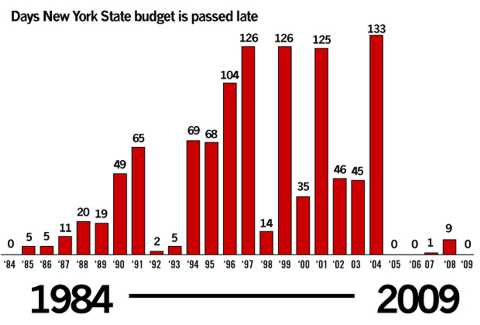
The NY state legislature finally passed the 2004 budget. That’s not funny but it is nearly true. The NY state legislature finally passed the current 2010-2011 budget last week, 125 days late. The press spin department called it a “fiscally responsible budget” with higher spending and an additional $4 billion in new taxes. New York will spend $136 billion they collect from you and you and you. And me, since some of the counted revenues come from Federal coffers. It is the fourth latest budget in New York State history.

Read that again. It is one of the latest budgets in New York State history.

“It takes more than 20 months to repair more than 40 years worth of damage,” State senator John Simpson (D-somewhere-in-NY-but-not-for-long) said as he harped on how much worse things were under the former Republicans’ rule.

Horse puckey.

source: http://parmenides.wnyc.org/media/photologue/photos/New%20York%20State%20budget%20history%20of%20delays.jpg

The pattern shows the legislature fritters when they aren’t afraid of the voters; they sort of buckle down when the voters are watching.

Everybody has an excuse. Whiners.

Legislators disagreed about capping property taxes. They disagreed about letting SUNY raise tuition. They disagreed about budget cuts if the hoped-for/planned-for/wished-for “FMAP” Medicaid supplements fall through. They disagreed about tens of millions of dollars of pork-barrel grants NY Gov. Paterson already vetoed (the legislature wanted to restore them in the final budget deal).

Incumbents called it the “most responsible budget” in a couple of decades.

Wow again.

Remember the veto? Gov. Paterson vetoed 6,709 line items of spending the Legislature tried to add, including $190 million in pork-barrel spending. Six thousand seven hundred items.

What are they, nuts?

We elect peeps for pretty much one reason: to spend our money on the things we want them to spend it on. We don’t elect them to fritter away their time or that money.

Former New York City Mayor Ed Koch got it right about members of his Legislature: “The good ones aren’t good enough and the bad ones are evil,” he said.

Sounds like a national sentiment to me.

Short. Not Sweet.

I must be a racist. After all, I’m white and conservative, and I don’t think we should have an African-American president.

There. I said it.

I AM™ absolutely convinced we should not have an African-American president.

Read the next sentence in full because regular readers know what I think of Mr. Obama’s ability to govern. I’m perfectly OK with Barack Obama as a black man or a “person of color” or a purple man with pink polka dots but we ought not have an African-American president.

We should have an American president. Period.

Anyone who thinks we should have a hyphenated president is just plain nuts.

“No person except a natural born Citizen … shall be eligible to the Office of President; neither shall any Person be eligible to that Office who shall not have attained to the Age of thirty-five Years, and been fourteen Years a Resident within the United States.” Not a natural born citizen of Europe. Not a natural born citizen of Antarctica. Not a natural born citizen of Africa. A natural born citizen of America. Those who become citizens here by birth or immigration are no longer citizens of somewhere else. They are Americans, darn it, not European-Americans nor Antarctic-Americans nor African-Americans.

Americans.

This whole argument irks me. Are there racist idiots in the Tea Party? Absolutely. Are there racist idiots in the Communist Party of the United States? Positively. Have the Lefty Loons trotted out the race card every day since 2008 to deflect us from their failed policies? Without doubt. Have the Tighty Righties stupidly responded to those slurs over and over again? Right again.

Former Vermont Governor Howard Dean called Fox News “absolutely racist” on Fox News Sunday. Vermont state veterinarian Robert Johnson also says there have been an unusual number of fox attacks this year, but it’s not cause for alarm. The latest attack happened a couple of weeks ago in Bennington when a rabid fox bit 8-year-old Rimmele Wood on the leg. His father killed the fox with an ax.

Some of our liberal friends are probably considering that solution for Fox News.

Perhaps everyone, not just the Wood family, needs the rabies shots. As my roofer friend Dino likes to say, sometimes I think I fell down the rabbit hole and we’re wandering around with Alice in Blunderland.