
Author Archives: Dick
Got M-m-m-m-management?
A lifetime ago in political terms I ran for state representative. I visited every dairy farm, rich and poor, in our then-two-Town district (Puffin East and North Puffin).
I spoke at some length with Etienne Chasseur, a North Puffin farmer milking about 75 head on 180 acres over on the Sweep Road.
“You need to sign on to the Canadian supply management system,” he told me. “I’m going broke here on an $11 milk check but my brother-in-law up north gets $18 U.S. for milking the same size herd.”
What, is he nuts? Etienne left out some of the story. I didn’t sign on then and would not now.
Vermont is a major dairy state with minor farms. The state defines a “large farm” as more than 600 cows; the median farm here now milks 120 head. Wisconsin, California, and even Nebraska dairy farms often milk 1,500, 2,000, or more. Many more. In 1991, a Vermont cow on one of our 2,381 farms produced about 15,000 pounds of milk per year. By 2000, average annual production per cow had risen to almost 17,500 pounds per year. (There were 11,019 farms here at the middle of the 20th Century.) Farmers measure milk production in “hundredweight” rather than gallons. About 12 gallons of milk weighs one hundred pounds.
Dairy farming here is unique because dairy farmers cannot set the price of milk and cannot pass along increases in operating costs. Neither Etienne Chasseur nor Wisconsin dairy farmer Paul Rozwadowski knows how much his milk sold for until the “milk check” comes in the mail. A month later.
Canada and the EU have a two-tiered system that offer farmers a (fixed) high price for “quota” milk, but a very low price for milk that is more than the quota for each farm. I’ve talked to some dairy farmers in Quebec. One compared his 150 cows to a 1,500 head herd in Wisconsin. Over the last dozen years, he made more total profit on 150 cows than the Wisconsin farm did on 1,500 for nine of those years.
The latest debate over dairy supply management began in 2007 and has picked up again.
The current milk pricing system is “inadequate, unfair and devastating family farms across the country,” Mr. Rozwadowski told the St. Albans Messenger. His last milk check brought in $13.80 per hundredweight for milk that he said cost $18/cwt to produce.
That price is based on dairy commodity sales. The USDA Federal Milk Marketing Order Office monitor the price of butter, dry milk powder, whey powder, and cheddar cheese sold on the Chicago Mercantile Exchange. The feds jinker with the numbers to come up with the mailbox price, or the price that the farmer actually receives.
So. What have we learned?
- The government sets the price farmers sell for
- Some farmers want to “level the playing field” by having the government also limit how much they can sell.
Where else could this plan this work? (1) Since the Obamanation owns General Motors, can we expect to see car sales limited to, say, 4 million units annually for all sellers and no more than 50,000 Chevy Volts sold prix fixe $65,000? If GM wants to sell more, the remainder must sell for $3,000 each. (2) Perhaps the feds should limit the oil companies to 15,680,000 barrels/day (about 5 million per day below current consumption) and fix the price at $180/barrel. Any production over the 15 million must be sold for $10/barrel. (3) Next, all manufacturers of men’s knit shirts will be held to 686 million units next year and the price set at $21 each wholesale. Anything over 686 million units must be wholesaled out for $6.
Did any of that really make sense to you?
Things that should be simple seldom are:
Try reading the Federal Tax Code
Got milk? Maybe, just maybe, farmers should look for a better way to price their milk instead of beseeching the feds for yet another set of regulations to hamper them.
It’s All About the Sex
Or is it?
Polly Wolly Diddle All Day, gekko said.
[If you haven’t been following this ongoing polylocution about boundless love, please read the first two pieces in the series along with gekko’s companion piece, On Betrayal, On Joy (Poly, Part 3) , for her take on spit-shining.]
I like sex. I like love better. And I guarantee the sex is better with a lover than with a sexer, something I did not know at 21. A question remains to resolve this week: one can have sex without love but can one have love without sex?
Polyamory, the Movement, talks about love and open communication and responsible non-monogamy. Polyamorists the people talk about the sex.
Important Note: Condoms break. Those involved in a polyanything relationships should plan regular bloodletting for the obligatory STD tests.
“Humans are the most sexual of all the primates, willing and able to do it just about anywhere, anytime, with anyone (and even with other species if the Kinsey report is to be believed in its findings about farmhands and their animal charges),” Michael Shermer wrote in Scientific American .
Old joke: Billy Bob and Luther were talking one afternoon when Billy Bob tells Luther, “Ya know, I reckon I’m ’bout ready for a vacation. Only this year I’m gonna do it a little different.
“The last few years, I took your advice about where to go. Three years ago you said to go to Hawaii. I went to Hawaii and Earline got pregnant. Then two years ago, you told me to go to the Bahamas, and Earline got pregnant again. Last year you suggested Tahiti and darned if Earline didn’t get pregnant again.”
Luther asks Billy Bob, “So, what you gonna do this year that’s different?”
Billy Bob says, “This year I’m taking Earline with me.”
Ba da boom.

Hugh (Call me Viagra) Hefner, going strong at 84, opened the doors to the sex party in December, 1953, with a $1,000 loan from his mother and a 50¢ cover price. Since then, sex in person, on television, in the movies, and on the Internet gets more hits than God and Mephistopheles combined (Sex: About 656,000,000 results; God: About 476,000,000 results; Mephistopheles: About 1,060,000 results. Source Google)
This week, while no-longer-androgynous gekko talks about lifestyle, I shall search for spit and spunk to prove that “it’s not just the sex.” Positive results under an alternative light source don’t prove love and the lack of bodily fluids doesn’t prove fidelity.
Over on the other pages, Nancy “came out.” Eleven years ago, she had sex with a man who wasn’t her now-ex-husband. She made the decision to cheat as well as to hide it from him. Sex.
The long-married Fred and Gwen Strong have Friday night date nights and have for a couple of decades. Sex. Fred and his girlfriend Carol spend every other Thursday evening at the Comfort Inn. Sex. Fred spends Saturday mornings sitting side-by-side with Bonnie in the comfortable chairs in the library visiting room; sometimes they simply read but often they talk. They usually hold hands. No sex.
Does there have to be sex to be lovers?
Intercourse always starts before coitus commences. When thousands of miles separate potential lovers, they could have months or years or millions of words before they have even one kiss.
Talking too close is far more dangerous than dancing too close.
Emily and Barny Feeler have had a kind of no worries online fling for years: proximity, immediacy, and blood tests not required. It’s fun and they could probably sustain it indefinitely — after all, they live thousands of miles apart. They get to play with words, play with ideas, and even play at sex. The new age way of touching someone without ever touching. No sex.
They have also learned enough about each other to become friends.
It’s all about the sex?
Were Nancy and her turning-point fling lovers? Were Fred and Bonnie? Fred and Carol? How about Emily and Barny as lovers?
The consensus view holds that having sex with a non-spouse is cheating but not having sex with a non-spouse is not, I wrote last week. The consensus view is frequently very wrong. If the poly relationship has no groping and panting, is it still what many call infidelity? I suggest that it is and not because Jimmy Carter ran into that attack rabbit or was unfaithful when lusting in his heart.
Relationships don’t fail because of sex present or sex missing. Relationships fail because the people in them stop liking each other.
Relationships succeed because the people in them do like each other.
Nancy and her brief crush probably weren’t lovers. They had a sexual attraction but she didn’t report on the bond she now understands she wants to feel.
Library Fred and Bonnie could be lovers. They have a long-term, intimate relationship, know each other’s children’s birthdays, and would go out on a rainy night to fix a broken down car.
Motel Fred and Carol meet the test. Carol has an intimate relationship with Fred that is similar to Bonnie’s. And, of course, they have sex every other Thursday.
Online Emily and Long Distance Barny are assuredly lovers. There is no sex but they know each other’s most intimate secrets from office gossip to menstrual cycle. They share everything and would do anything for each other including fly across the country to move a … bureau.
And that, dear reader, is making love.
[Editors Note: The rest of this series on Polyamory may be found here . Please also read gekko’s companion pieces, Poly Blogging , and the newly minted part 3, On Betrayal, On Joy , for her take and lots more commentary.]
“When there’s someone that should know
then just let your feelings show
and make it all for one and all for love.”
Wordless Wednesday
What Do We Pay Them For?
And why do we pay so much?
About a lifetime ago, I paid income taxes to both New York and Vermont. My job was with a manufacturer on the left side of the pond but New York had those baby-puke colored license plates at the time and I really didn’t want to live there; we moved to the home of the green plates instead.
I didn’t much like paying income taxes to New York.
I still wouldn’t.
The NY state legislature finally passed the 2004 budget. That’s not funny but it is nearly true. The NY state legislature finally passed the current 2010-2011 budget last week, 125 days late. The press spin department called it a “fiscally responsible budget” with higher spending and an additional $4 billion in new taxes. New York will spend $136 billion they collect from you and you and you. And me, since some of the counted revenues come from Federal coffers. It is the fourth latest budget in New York State history.
Read that again. It is one of the latest budgets in New York State history.
“It takes more than 20 months to repair more than 40 years worth of damage,” State senator John Simpson (D-somewhere-in-NY-but-not-for-long) said as he harped on how much worse things were under the former Republicans’ rule.
Horse puckey.
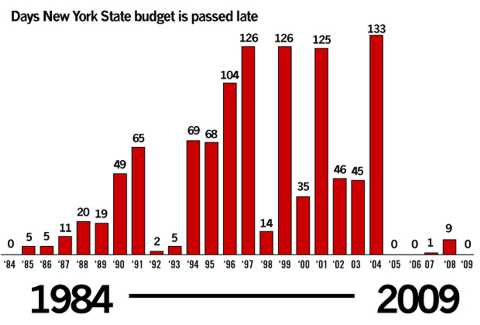
The pattern shows the legislature fritters when they aren’t afraid of the voters; they sort of buckle down when the voters are watching.
Everybody has an excuse. Whiners.
Legislators disagreed about capping property taxes. They disagreed about letting SUNY raise tuition. They disagreed about budget cuts if the hoped-for/planned-for/wished-for “FMAP” Medicaid supplements fall through. They disagreed about tens of millions of dollars of pork-barrel grants NY Gov. Paterson already vetoed (the legislature wanted to restore them in the final budget deal).
Incumbents called it the “most responsible budget” in a couple of decades.
Wow again.
Remember the veto? Gov. Paterson vetoed 6,709 line items of spending the Legislature tried to add, including $190 million in pork-barrel spending. Six thousand seven hundred items.
What are they, nuts?
We elect peeps for pretty much one reason: to spend our money on the things we want them to spend it on. We don’t elect them to fritter away their time or that money.
Former New York City Mayor Ed Koch got it right about members of his Legislature: “The good ones aren’t good enough and the bad ones are evil,” he said.
Sounds like a national sentiment to me.