Wordless Wednesday
The All Arts Council opens the Bakersfield & East Fairfield Caravansary Art Festival with a reception at the new East Fairfield Arts Center today at 5 p.m. The show will run through Sunday.
For centuries, travelers on the Silk Road stopped in “caravansaries,” the bustling caravan stops that were the center of cultural as well as commercial exchange. Caravansaries brought together adventurers, artists, entertainers, monks, nomads, pilgrims, and traders from around the known world to share their art, their music, and their stories around a bonfire.
Burning Man.
70,000 “Burners” will come together on August 25 in the Black Rock Desert of Nevada to create a community of art, music, self-expression, and self-reliance. They will disappear September 1, having left no trace whatsoever.
That week will see sculpture, installations, performance, theme camps, art cars, and costumes all with the caravansary theme.
We can preview some of the traveling art and music at the Bakersfield & East Fairfield Caravansary Art Festival as well as a quartet of art cars plus the All Arts Council’s own burning art exhibit.
The AAC burning art exhibit includes a pyrosculpture by Vermonter Kate Pond, a dish flambee from Kitten Ellison, and the Burning Bush, a new image by Highgate photographer David J. Griggs.
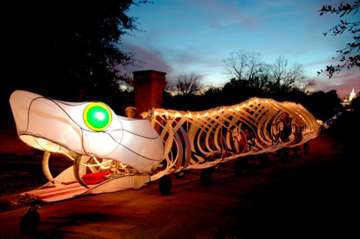 It’s all about the camel. Or the wheel. Caravans require one or the other (it’s a law) so the event will feature the Austin Bike Zoo fresh from Spark! Mesa, Arizona’s, Festival of Creativity. Bike-builders, puppet-makers, and performers have created a nine- or ten-seat bicycle with a frame as thick as my thigh, eight-foot tall wheels, an old-fashioned bike bell, and training skis, just in case. They will bring butterfly bikes that range from 10-18 feet in height plus animated bat and owl bikes. The centerpiece is the giant rattlesnake bike that measures 80 feet in length and will offer rides for all attendees. There is no truth to the rumor it will be pulled by a camel.
“We have to have music!” Maple Festival main stage organizer Andre Maquera said.
“Bassnectar, the Mutaytor, and the March 4th Marching Band will share the stage with a one-night only reunion of 8084 plus a special solo performance on the big screen by jazzman Will Patton,” he said.
“I’ve spent the winter working on dub-step,” Mr. Patton said from Paris, France. He has also been exploring house, witch house, dub, hardstep, dancehall, dance-floor, punk, post-punk, “Noise,” new wave, nu wave, No Wave, emo, post-emo, hip-hop, conscious hip-hop, alternative hip- hop, jazz hip-hop, hardcore hip-hop, nerd-core hip-hop, Christian hip-hop, crunk, crunkcore, metal, doom metal, black metal, speed metal, thrash metal, death metal, Christian death metal, and, of course, shoe-gazing, among others on the mandolin. He expects to have several other local musicians back him for this set.
Joni Mitchell and Grace Slick are scheduled to appear later in the week in a series of acoustic music and other performances at the new East Fairfield Arts Center Camp Café.
The Arts Center is a multi purpose organization and building that includes prime performance space for music and art exhibits.
According to the rule of desert hospitality, the Festival will provide free entry and water for travelers who stop at our tents. The Bakersfield & East Fairfield Caravansary Art Festival is open to all and admission is free but you need a free ticket to get in the gate. Tickets, schedules, and other background materials are available at ticketmaster.allarts.org. Admission is FREE but you must have an advance reservation to participate. Proceeds will benefit local art projects in Franklin County.
This event is not sanctioned by the 334 Green Mountain Burners (find them on Facebook) or the Bruleurs de Montreal.
Visit my site at dickharper.com for more events in April.
Almost 50 years ago, my mom’s friend Eddie Maranowski was a photographer for the Daily Local News but he also owned a shoe store right next door to the Warner Theater where I was an usher.
Eddie hired me for a promotion for a brand of shoe he sold. I was the (very local) “Kolonel Keds” for the opening of a now-forgotten movie at the Warner. I greeted kids, handed out trinkets, and looked heroic.
Keds™ is an American brand of canvas shoes with rubber soles introduced in 1916 by U.S. Rubber (the company later known as Uniroyal). In 1960 they became the first mass-marketed canvas-top “sneakers” because the rubber soles let us sneak up silently on spaceships. Kolonel Keds flew Bell™ jet packs, rescued kids, and extolled the virtues of the scientifically designed, built-in booster pad in the shoes.
Eddie gave me a few bucks and a brand new pair of sneakers. I didn’t get to keep the Bell crash helmet, though.
I agree.
See, when you hear an expert say we should monetize anything you know he means he wants money to flow from you to him.
That’s backwards.
Ralph Lauren wanted me to embroider his polo pony on my shirt for free, not to tell the peeps I met how cool I am but to market his shirt to the peeps I meet. He never responded to my request for a share of the profits, so I don’t wear his shirts. On the other hand, I painted Lanson Machine on the fenders of the race car because they did pay for that.
Data is the currency of the Internet.
The World Economic Forum in a 2011 report called personal data the “new oil.” Data brokers estimate information about you is worth a fraction of a cent for a single piece of data to $5,000 or more for a full digital profile.
The Denver Post had 25 trackers on a recent visit: Adblade, AddThis, BrightTag, ChartBeat, Crowdynews, DoubleClick, Facebook Connect, Google +1, Google Adsense, Google Analytics, LinkedIn Widgets, Lotame, Mixpanel, NDN Analytics, New Relic, Newstogram, Omniture (Adobe Analytics), Outbrain, Press+, Quantcast, ScoreCard Research Beacon, Twitter Badge, Twitter Button, Tynt, and Visual Revenue. Surprisingly, nytimes.com set only seven the same day: Audience Science, Brightcove, ChartBeat, Conviva, Dynamic Yield, Google Analytics, Krux Digital, New York Times Beacon, ScoreCard Research Beacon, and WebTrends.
Judge Lucy Koh of the Northern District Court of California found last year that Google might have violated wiretap laws.
It’s time the money start flowing from them to us. Amazon wants to set a tracking cookie to see where I click next? That’ll be one cent, please. TVGuide wants to sell a third-party cookie so someone else profits from where I click next, too? That’ll be a nickle, please. Verizon wants to know where I am to connect my phone call? Cool. Verizon wants to sell where I am to the donut shop? I want a dime for that. Andy Monfried might sell my email address to ABCMegaUltraCorp? I get a tenth of a cent each time. Spamford Wallace emails me an ad for a penis reduction tool. That’ll cost him a buck. For the record, I never did collect from Spamford.
This could work. All we need is a micropayment system to collect it and pay us.
A micropayment is just what it sounds like: a very small sum of money that usually transfers from my account to yours (or vice versa) online. Unfortunately, ystems that allow transactions like these, from fractional pennies to a few cents each have seen little success so far. W3C (the World Wide Web Consortium) planned to include micropayments in HTML but those efforts have stalled, so there are no widely used micropayment systems on the Internet. CentUp is a mostly blogging and podcasting system that collect donations for content. I haven’t seen many sites that use it. Flattr uses actual banks. M-Coin and Zong charge your phone bill. PayPal will do charges under $12 but their fees are high. IBM and Visa are among the big operators who have tried and failed. It was just too expensive, I guess. Bitcoin might work.
Once upon a time, businesses spent money directly — with surveys and coupons or discounts on their products, for example — to harvest data about us and to mail us enticements to buy more. Now they want to do it for free. Eddie paid me to help him sell those sneaks.
Who knows? A side benefit might be to the post office. If we raise the cost of entry high enough, advertisers might just go back to snail mail.
“We’ll insure 30 million Americans who don’t have insurance,” Barack Obama said in 2008.
“We’ll insure 27 million Americans,” Barack Obama said in 2009.
“We’ll insure 15 million Americans by 2013,” Barack Obama said in 2011.
“We’ll insure 7 million Americans by March of next year,” Barack Obama said when he moved the deadline in 2013. Again
“We’ll insure 6 million Americans by March 31,” the White House said in last week.
“We’ll insure 2.8 million Americans by 2016,” the White House will say in July.
According to the U.S. Census Bureau, 48.6 million Americans had no health insurance in 2009, 50% more than Mr. Obama originally promised Obamacare would originally cover. “There are still more people uninsured today than when Obama was elected president,” U.S. Rep. Jack Kingston (R-GA) said recently.
He’s mostly right. 15.4% of Americans were uninsured during the first quarter of 2009. That’s 47.7 million folks. 15.9 percent of Americans are uninsured today. That’s 49.9 million folks.
The Obama administration’s original goal was to enroll 30 million 15 million 7 million^H^H^H 6 million people by the end of the open enrollment period on March 31. Around 20% of those will fail to pay and most of those who do follow through already had had insurance that Mr. Obama cancelled.
That’s today.
Do you have insurance? Today is your last day to sign up.
Do you have insurance today?
45.1 million Americans won’t.
And the hidden gotcha: your premium in 2015 will be significantly higher than those in 2014. Aetna and WellPoint predict that most carriers will raise rates by “double digits.” So will your taxes.
BREAKING NEWS: healthcare.gov was down again for much of March 31 under the crush of the tens of people trying to sign up at the last minute.