Are Republicans Really Anti-Science?

In Mother Jones, Kevin Drum takes on Chris Mooney’s stance In The Republican Brain. The question both writers pose is “Who has been anti-science, and why?”

I know some people who are anti-science but they seem to come from all over the political spectrum. In fact, I know more liberals who support the false god of political science than conservatives who denounce the real thing. And that is the crux of the problem.

When Buster Door said to me, “You’re anti-science” he and his friends are mostly saying “You’re against what I oh-so-strongly believe.” They have no rigorous proof to back up either the claim or what they believe. NPR’s Ira Flatow who “barely grasped chemistry” is a good example of that.

“The science of climate change is fixed,” he says regularly on his weekly radio show, Science Friday. “Why can’t people just accept that [man causes it] and move on?”

I don’t think anyone would argue for a static climate. I don’t understand how anyone who has ever seen a 5-day weather forecast could argue that we know enough about climate to “fix the science” in Mr. Flatow’s favorite concrete.

Stephen Hawking wrote in A Brief History of Time, “A theory is a good theory if it satisfies two requirements: It must accurately describe a large class of observations on the basis of a model that contains only a few arbitrary elements, and it must make definite predictions about the results of future observations.

“Any physical theory is always provisional, in the sense that it is only a hypothesis; you can never prove it. No matter how many times the results of experiments agree with some theory, you can never be sure that the next time the result will not contradict the theory. On the other hand, you can disprove a theory by finding even a single observation that disagrees with the predictions of the theory.”

The theory of anthropogenic climate change describes a smaller-and-smaller class of observations on the basis of a model that contains an increasing number of arbitrary elements. Many proponents ignore historically larger climate swings that do not fit the theory. Many proponents ignore solar influence that does not fit the theory. Many proponents ignore the inconvenient truth that new temperature data shows the planet has not warmed for the past 15 years which does not fit the theory.

Mr. Drum makes some good points but he overlooks the most obvious when he writes, “Doubt about climate change is obviously motivated by a dislike of the business regulation that would be necessary if we took climate change seriously…”

I just can’t see that.

I see that doubting anthropogenic climate change means we understand how science works.

And I see the political scientists of anthropogenic global weirding as worshipers of Ptolemy.

Pretty bright guy, our Ptolemy. His Harmonics defined music theory and the mathematics of music. His Geographia not only compiled world geography in the Roman Empire, but also used coordinates and established latitudes and longitudes. But he also believed the Earth was the center of the Universe. It took 1500 years before Copernicus could dispel that.

I know these pieces are always All About Me, but I also know I am not the center of the Universe.

If it takes us another 1500 years to understand that bankrupting ourselves on political science so we have nothing left to adapt to the looming colder or hotter lands and seas, we have indeed met the enemy.

He is us.
Everything I Know

Everything I know about history, I learned from Thomas B. Costain.

That would truly annoy Frank Wright, the exceptional high school history teacher from whom I also learned a lot. I tell the Costain story often. It is mostly the truth.

Canadian journalist and editor Thomas B. Costain published his first best-selling historical novel, For My Great Folly, at the age of 57. He had toiled in the writing trenches for most of his working life before Folly. Mr. Costain’s fiction relied so heavily on historic events that one reviewer said “it was hard to tell where history leaves off and apocrypha begins.” Mr. Costain made the story of Joseph of Arimathea and the lowly Basil of Antioch come alive for millions of Americans, including me. The Silver Chalice may have been the first historical novel I ever read.

I had read Chalice, the Tontine, Below the Salt, and the Last Plantagenets before leaving for college. My mom, a Swarthmore alum, also knew American writer James A. Michener and introduced me to his work as well.

Mr. Michener penned some of the best known sagas in literature, novels that spanned the lives of uncounted generations in exotic or previously under reported locales. He was known for his meticulous research which let him work the entire history of each region into his stories. I can almost say I know more about the Chesapeake Bay from reading Mr. Michener’s Chesapeake than from growing on the water there.

The Italian government lauded biographical novelist Irving Stone for the way he highlighted Italian history in the Agony and the Ecstasy, the life of Michelangelo Buonarroti.

So.

How do we separate fact from fiction when our favorite novelists leaven their rising stories with actual history in search of a truth? Or in search of a good story?

It is hard, after reading Costain, not to mistake the Grail story as truth. It is hard, after reading Michener, not to mistake the many generations of the Buk, Bukowski, and Lubonski families as real.

Fast forward.

Jon Stewart is a brilliant satirist. Pew Research Center’s search for the most admired American journalist has Mr. Stewart, the fake news anchor, at Number 4, tied with actual news anchors Brian Williams and Tom Brokaw of NBC, Dan Rather of CBS, and Anderson Cooper of CNN. Dan Rather? OK, it was a 2007 poll. The Daily Show does have pieces of substantive news but satire can’t handle the whole truth and Mr. Stewart has repeatedly insisted that he is only a comedian on a fake news show.

Monologist Mike Daisey played the Lane Series at the Flynn Theater in Burlington, Vermont, this weekend. His The Agony and the Ecstasy of Steve Jobs has caused a national foofah over what is and what isn’t true in his monologue about Apple and its manufacturing practices in China. In January, NPR’s This American Life and its host, Ira Glass, published a critical 39-minute story that detailed the appalling Chinese iPhone plants, a program adapted from Mr. Daisey’s theatrical monologue.

Last weekend, Mr. Glass retracted the story.

The most admired reporter of our times, Edward R. Murrow said, “To be persuasive we must be believable; to be believable we must be credible; to be credible we must be truthful.” From Costain to Michener to Stewart to Daisey to Survivor we’re blurring the line between truth and fiction.

We in the news business must be truthful. But most of all, we must remember that entertainment has no such need.

“Get the facts, Dick,” Frank Wright would tell me. “It’s not the truth without the facts.”

Of course, I’m not sure Mr. Wright ever watched “reality TV.”

Happy Poly Moment, II

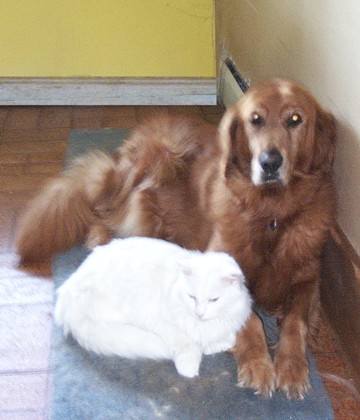
Despite my abundent furriness, both North and South Puffin have been a fur free zone for a few years. We were blessed with Ruffy, our rowdy, white (and photogenic) cat for over twenty years. In a stroke of good luck, the local Humane Society lent us TMWCNBNITNG (whom we named Gwendolyn Dandelion Whine or Wendy, for short) for a long weekend and we kept forgetting to take her back. See, Ruff was lonely and they really hit it off.

FriendsI hate to think what the overdue fine is by now.

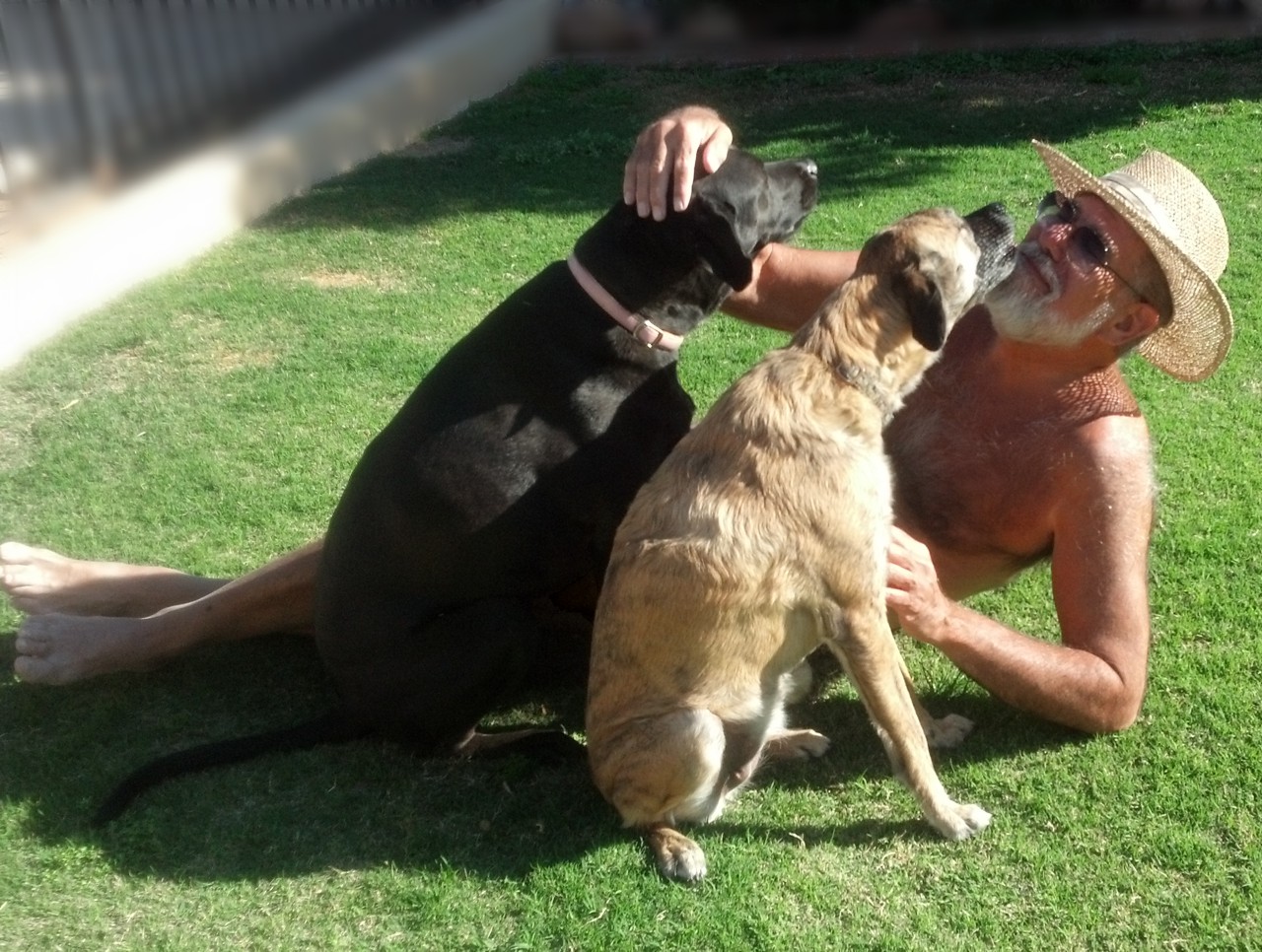
Wendy and Ruff have been gone for a few years now, so I live in a fur-free zone. I love cats and dogs. This is the only the second extended period of my life without one or the other around. (The first was in college when, like now, I wasn’t around enough to give a pet continuous attention.)

When I get the opportunity, I stock up on fur time.


Friends


The (other) April First columns.