How Many Millionaires?

“Rich politicians take care of their own,” Fred Grimm wrote in the Miami Herald yesterday. “The rich are different from you and me. Well, me anyway. And they’re damn well positioned to keep it that way.”

Here’s his proof: Florida has a fabulously wealthy governor-elect who spent $73 million of his own money to get elected and a Legislature “laden with millionaires.” 18 millionaires will be “slumming in the state Senate. That’s 18 out of 40 senators.” 34 millionaires vote in the House. Out of 120 state reps. “Rich reps are forced to mingle with the unwashed rabble,” Mr. Grimm wrote.

“The U.S. Congress wallows in even more disproportionate affluence than our elected moneybags in Tallahassee.” He used the Center for Responsive Politics to find that 261 members of Congress are millionaires, and 55 are worth more than $10 million. Median wealth in the Senate rose from $2.27 million to $2.38 million last year.

I apologize in advance. I tried to make this funny. It isn’t.

This kind of writing irks me. My neighbor Stan is a millionaire. He doesn’t feel rich. In fact, he complains about anything but rich. A Texas friend, Billy Bob, is just about on the median wealth of the Senate. He feels richer than I do, but he ain’t buying jet airplanes. Not many other millionaires are, either. So the Herald columnist who wants grimly to stick it to we fabulously wealthy types mingling with the unwashed rabble seems to have left out a fact or two.

Let’s look at some real figures, albeit from 2009 before the electoral shakeup. Only about 17% of Congress Critters are women although 51% of Americans are. 178 representatives and 58 senators are lawyers although only .3% of Americans are. 400 representatives and all but two senators have earned college degrees; many have advanced degrees although only 27% of Americans do. The average age in the House is about 56 and in the Senate, almost 62 although the average age in America is 37.

So, it looks as if our Congress critters are mostly rich, white, college-educated lawyers between 55 and 64, and the general population isn’t.

The general population is about 37 years old, and a mixed bag of ethnicities and schooling. Just .7% of them overall are millionaires. Zero point seven percent.

So what happens when we compare Congress critters to mostly white, college-educated lawyers between 55 and 64? Or even just to college-educated Americans?

The Federal Reserve Bank looks at the median value of financial assets for most folks in America, primarily so banks can sell us checking accounts. The median is the “middle number” of a sorted list of numbers so half the numbers in the list will be less and half the numbers will be greater. The smaller numbers can be a lot smaller or just a little bit smaller but, in this case can never be less than zero. The bigger numbers can be just a teeny bit greater or can be hugely larger.

The Fed reported on those median values. It turns out that households of people aged 55-64 had about $95,200 in cash and stocks in 2007 (college graduates of all ages held slightly more at $99,400). Household median “nonfinancial assets” like your house and your car was $347,000 for the Congressional age group and $435,400 for college graduates of all ages. So the mid-line for college grads of any age is to be half a millionaire.

Half the college educated households are worth more than half a million?

Mr. Grimm didn’t tell us that.

27% of Americans have a college degree. 5% of Americans are “rich” millionaires. That means that about a fifth of Americans with a college degree are probably millionaires.

Mr. Grimm didn’t tell us that either.

Perhaps Mr. Grimm spent Thanksgiving with a can of Spam so he wants us to swallow his turkey.

Perhaps we need more college educated households although that offers no guarantees. The BLS reports that more than 482,000 college-educated Americans are customer service reps. Over 100,000 college-educated Americans are maids and janitors; 5% of those have a Ph.D.

And perhaps, as Mr. Shakespear reminds us, our bigger problem with Congress is the number of lawyers rather than the number of rich lawyers.

Mr. Grimm irks me because he trotted out an abundance of ogre words and a sparse few facts to back them up. I guar-an-damn-tee you that being a millionaire ain’t what it used to be.

I searched for a biography of Mr. Grimm who says “the way [the rich] see things . . . well, they’re different from you and me.” No joy. He was a general assignment reporter at the Herald after working for other newspapers. He has been a columnist there for about 20 years. I’m going out on a limb here without giving you the data I wanted him to give us, but I’m thinking Mr. Grimm is a limousine lib. He probably has a college degree. He certainly rubs elbows with the very same kind of folks lounging around Tallahassee and Washington that he excoriated yesterday. After all, the BLS also reports that the top 10% of news analysts, reporters, and columnists (meaning senior staff at major metro dailies) earned more than $77,480 per year.

Columnists are supposed to make waves. I do.

But Miami columnists ought not complain about how cold it is in South Florida when the fact show it is 60° colder in North Puffin. We do better making waves with facts that stand up to daylight scrutiny.

Warning: Unexpected transition ahead. Follow along and be careful where you step.

I will address the question, Is Liberalism really Liberalislam another time.

The Herald column does what so many limousine liberals and fundamentalist Muslims alike want to do: drag down the rich so everyone is poor and scrabbling in the dirt.

Me? I’d rather be a millionaire so here’s my proposal. If you are so apologetic for your personal wealth, give me your fortune. I guarantee I will hire a dungeon master to help you feel really ashamed.


You libs want something worth groaning about? Mr. Grimm could have offered a couple of valid statistics:

  • In about 40 years, the average U.S. CEO pay has grown by an order of magnitude. Mine hasn’t.
  • Congress critters upped their average wealth by 16% in 2009, a year the rest of us took a hit.

Americans should celebrate that some of us can become wealthy. Want to do better? The answer is not to tear down those who have but rather to improve the odds for the have nots.

A Nation of Suggestions

The immigration debate moves to the U.S. Supreme Court on Wednesday in a challenge to the Arizona law that punishes employers who knowingly hire illegal workers. Court watchers expect that this action will signal how the court might handle the more expansive Arizona immigration enforcement law SB1070.

The governator of California, Arnold Schwarzenegger turned down a commencement address in Arizona last May because “with his accent, he was afraid they would try to deport him back to Austria.”

I suggested then that we should, perhaps, boycott Los Angeles since that whole city had lined up to encourage blatantly illegal behavior.

Arizona’s law requires employers to verify the eligibility of new workers through a federal database. Arizonans hoped it would shrink their status as the center of immigrant smuggling.

“Immigrants can’t ‘steal jobs’ nobody else wants,” my friend Lido “Lee” Bruhl suggested. “If it weren’t for the guest workers, all those jobs would go to Mexico or someplace else overseas.”

Huh?

“And don’t even get me started on the so-called ‘economic burden’ of immigrants,” he continued. “The reverse is actually true. They receive less health care, less welfare, less public schooling than our own downtrodden do. Immigration actually improves economic conditions, because those so-called ‘illegal’ immigrants spend money on the same things everybody else does.”

Yeppers. Like coyotes. And sending money back to the economy of Mexico.

Um, Lee? Hello, Lee? Earth to Lee?

Congress has jinkered with how aliens may cross the border and with immigration policy since the Naturalization Act of 1790. Back then, only “free white persons” of “good moral character” could become naturalized. Fortunately for them, most of today’s Congressmen are native born. Congress increased the residency requirement to five years in 1795, a requirement remains the law of the land to this day.

The McCarran-Walter Act of 1952 has been amended many times and is contained in the United States Code as the basic body of immigration law. That law defines who is an alien and delineates the rights, duties, and obligations of aliens in the United States. The alien must establish that he is admissible to the United States as an immigrant. It’s the law.

“That doesn’t matter,” Lee said. “These people are here now.”

Ignorance can be fixed.
Stupidity is forever.

“Our border with Canada is the longest nonmilitarized border in the world,” INS Executive Associate Commissioner Michael A. Pearson told Congress in 1999. “This border, however, is not unmonitored or uncontrolled. The INS maintains 114 Ports-of-Entry (POEs), 8 Border Patrol Sectors, and 44 Patrol stations along the 3,987 miles of border with Canada (excluding Alaska).” The INS maintains another 43 Ports-of-Entry along our 1,969 miles of border with Mexico.

Perhaps Lee would like those Ports of Entry emptied so people guest workers can simply walk across anywhere.

I understand why liberals like Lee don’t geddit.

Laws are only advisory.If your Congress decrees that an evil, dirty, dark business must or a nasty, rich Republican baron must give up property or starve Mexicans by increasing ethanol in gasoline, why then those laws must be enforced.

On the other hand, if the other Congress, the one made up of evil, dirty, dark businesses and nasty, rich Republican barons decrees that crossing the border is illegal, why those laws are safe to ignore.

By George, I geddit now.

“It’s How You Make It Long”

Elizabeth Arden sent me a family picture of herself with her parents recently. Liz is a bit younger than I am but we are of about the same generation which means our parents are of the same generation.

http://farm3.static.flickr.com/2175/2078646616_8e7d356ed2_o.jpgIn the interests of protecting the unexpected, this isn’t that photo. But it is similar.


 

My parents were about my age now for most of their latter years. I know that’s a bit of difficult math for most of us but it follows very nicely from a serious problem my mom had about 20 years ago when I celebrated my fortieth birthday.

See, she wasn’t celebrating.

After all, how could a 39-year old woman have a 40-year old son?

Anyway I was struck by how old Liz’s parents looked. They’re octogenarians, after all, but how could they look that old? Most of the people I know that age are active, vital, busy, and engaged. They golf. They climb mountains. They live on boats. They build street rods.

I Googled™ up a bunch of images for people that age. The results are about evenly split between people who look like kids of 70 or so and nonagenarians.

Collage of Older Americans from www.wvgov.org/photos/422/1703/600x360.aspx, www.mdpls.org/news/entry/images/mayPrograms/older-americans.jpg, and www.montanaseniorcenter.org/bozeman/2008 older americans day 040.jpg
About 25 years ago, my mom had a nearly out-of-body experience — or at least out of her socks — at the intersection of High and Gay.


I’ll give you a minute.

The Borough of West Chester is the county seat of Chester County, Pennsylvania. The county, one of William Penn’s original three, was settled mostly by Quakers in the early 1700s. U.S. Capitol architect Thomas U. Walter designed West Chester’s classical revival courthouse.

Interesting place, West Chester. My mom knew Dave Barry when he was on his first job as a reporter at the borough’s Daily Local News. She tried to convince composer Samuel Barber to open his home there for Chester County Day. Smedley Butler, the Fighting Quaker and the most decorated Marine in U.S. history was born there. Buffalo Bill Cody lived on East Washington Street. Jon Matlack and Kevin Orie were born in West Chester; Sean O’Hair and Cole Hamels both live there now. Claude Rains lived there.

The borough was the operational headquarters of Commodore International. QVC has its headquarters next door in West Goshen Township.

It is, to my knowledge, the only place on Earth where the principle avenues are High Street which runs north-south and Gay Street which runs east-west. I’m embarrassed to say there was a Starbucks at that corner the last time I looked.

“I was crossing the street when a taxi almost ran me down,” my mom said. “The only thing I could think of was the headline in the Local: ‘Elderly Woman Slain by Taxi‘.”

Fortunately, she was a spry old lady of retirement age and she leapt back onto the curb.

I don’t think Dave Barry would have written it quite that way.


Advertisement for Virgin Loans from www.puppiesandflowers.com/blogimages/sept07/virginLoans.jpg

Off With Their Heads?

Fifth-grade teacher Rigoberto Ruelas committed suicide in Los Angeles in September.

The California teacher was found dead in a ravine after the Los Angeles Times released a database that ranked teachers by name. Mr. Ruelas, whom colleagues said was “so dedicated that he spent much of his personal time outside school working with students,” was listed as “less effective than average” based on how his students did on standardized tests.

Less effective than average.

My party-wall neighbor just had the plumber in. Earnie Alexander had to dig a tunnel under the house to repair a broken sewer pipe. I’m hoping that Earnie is more effective than average. Otherwise my feet are likely to get wet. And stinky.

Less effective than average.

Our friend Tom “Parle-vous” Parlett is a nuclear engineer who worked (note the past tense) for one of the few remaining Fortune 500 manufacturers of power plants. A few years ago, looking for a way to reduce payroll, his employer implemented forced ranking. The intense yearly evaluations identified Parle-vous as “less effective than average.” That bottom 10 percent set him up for a buyout which he took.

I don’t like forced ranking because it decimates morale. But the first half of the equation, the intense yearly evaluations to measure achievement, tells us whether or not we are doing out jobs. (Parle-vous is now the top performer in a different organization.)

We don’t have a big pot of money to offer [teachers] to sign off on performance contracts, Monroe County School Board Chair John Dick told Anne O’Bannon this morning on the Morning Mix. Means there will be no way to tell if we are doing our jobs in the Keys.

Less effective than average.

A Broward County history teacher wrote to the Miami Herald ombudsman about the suicide. “Ruelas will not be the only teacher casualty if … attacks [in the news media] continue,” that teacher wrote. “…You will see that the coverage has been overwhelmingly pro ‘reform,’ with teachers getting much criticism. There has been very little defense of teachers.”

Huh.

A teacher commits suicide because it suddenly became public that he maybe wasn’t as good at what he did as his press kit said he was.

Toyota advertises that, nationwide, 80% of all their cars sold in the last 12 years are still on the road (of course that means that about 19,000,000 cars have been abandoned, crushed, or sunk in lakes around Chicago). Nationwide, 7,000 students drop out every day and only about 70 percent of students graduate from high school with a regular high school diploma (of course that means 16,800,000 of today’s students will end up on the dole). Nationwide, Toyota’s recall troubles over gas pedals and other sudden acceleration glitches standing at at least 5.3 million vehicles across much of their product line (of course, that means 85 percent of recent Toyotas with probably won’t kill their passengers but 15 percent could).

Less effective than average.

Congress very nearly demanded Akio Toyoda commit hara-kiri.

Teachers demanded raises.

Cleanroom

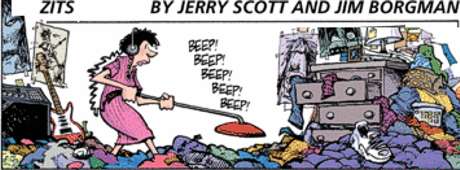
Teenage clutter is one of the common threads in the Zits comic strip.

http://www.chron.com/apps/comics/showComick.mpl?date=20101114&name=Zits
I have raised two (now-thankfully-former) teenagers, so I relate to the clutter but I don’t remember my own teenaged years quite the same way.

See, back in the days that marked my own adolescence, when we walked three miles through the waist deep snow to school, uphill each way, we didn’t have that much stuff.

My parents spent their teen years in the Great Depression and it defined them — and me — in many ways. I have reused and repaired and recycled if I couldn’t reuse or repair far longer than Kermit the (green) Frog. I hate to throw anything away that might be somehow handy later. And I don’t buy materiel without due … consideration. As a kid, they (and later I) wanted for little. We eventually had a teevee. We had an end room full of books. We had a boat. We had a garden and two cars. We ate and dressed as well as anyone else I knew. I still wear khaki slacks and blue cotton button down oxford shirts, of course. I didn’t get a used dog until I was nearly 50; nothing but new dogs before that. And I gave away our only used cat.

But we didn’t have a lot of stuff.

Oh, sure, we had washing machine and a dryer in the kitchen because that’s where my mom wanted them. And two vacuum cleaners, one for upstairs and one for downstairs.

It surprised me to learn that the U.S. had a small boom in middle-class home ownership before World War II. The post-war boom apparently built on that, and on the pent-up demand from the Depression. The war stopped the fledgling consumerism and it took several years for the factories to gear back up, years that many returning G.I.s spent in college. Consumers started finding stuff to buy again in the 1950s. My folks bought an brand new 1950 Ford convertible. The television didn’t come until 1955. Got the “little boat,” a 21-foot cabin cruiser, in 1957.

But we didn’t have a lot of stuff.

Oh, sure, I had a Rawlings glove but it lived in the “toy box” on the back porch. There was no plethora of cleats and Air Jordans and walking shoes and running shoes and everyday sneaks and splashing-around-getting-mucky sneaks and sandals and Crocs. I had a pair of Keds. In the closet.

We had two phones in the house. I never had one in my room.

The 80s brought us the boombox. I truly have never owned one although I did borrow my dad’s transistor radio to carry to school in fifth grade.

Motorola sold the first cellphone in 1984. I didn’t have one. Or a computer, or a smart phone, or a TV in my room

We didn’t have a lot of stuff mostly because there wasn’t nearly as much stuff to have.

In Zits, mom Connie Duncan needs a metal detector to find her car keys in son Jeremy’s room. Maybe the Duncans “gotta move, gotta get a bigger house. Why? No room for [their] stuff anymore.

I didn’t need to move until much later in life. Back then, I didn’t store my clothes on the floor.