Pooh Was Not an Early Adopter

I am a Bear of Very Little Brain, and long words bother me.

It is more fun to talk with someone who doesn’t use long, difficult words but rather short, easy words like “What about lunch?”

“An early adopter or lighthouse customer is an early customer of a given company, product, or technology; in politics, fashion, art, and other fields, this person would be referred to as a trendsetter.”

I’m not old enough to have bought RCA’s CT-100, the first production color TV, but I did carry the first battery powered transistor radio to my elementary school so I could be schooled in the proper musical offerings of WFIL.

And speaking of appliances, we were about the last on the block to get a television at all (it was a 19″ black-and-white RCA that my dad bought used for $75 in 1955) and the last to get a microwave oven. I bought that new, but it was by then deeply discounted.

The “early adopter tax” refers to the trend of new products costing more when they first go on sale than later in the product cycle.

I hate to pay taxes. Hate it.

On the other hand, my great-grandfather had the first railroad train in a front yard in Doe Run and we were the first on our block to own a boat.

I’m a gadget guy from a long line of gadget guys but since bright and shiny long words like early adopter never swayed us, we ended up buying what we needed at the time we needed it, rather than the moment it appeared on the market.

I may not have been the first kid to trade my slide rule for a calculator but I was certainly in the top few; that was in the days when a good K&E slip stick cost $29.95 and the nixie-tube, 4-function calculator cost $179.95, about six times that. Of course the calculator could add and subtract, something I have never done effectively on a slide rule.

I never owned an IBM 5150, but I did build a Sinclair ZX80 which I replaced with one of the early Commodore C-64s. I ran my first business on that Commodore computer and might still be using it today had not the spreadsheets gotten too large for storing on a single floppy disk. My friend Rufus has a Betamax somewhere. On the other hand, he gave up his Pulsar watch for a Casio C-801 about 30 seconds after it arrived on the market. He still has a couple of those.

Liz Arden switched briefly from a standalone GPS to the Google™-driven app in her smartfone. She just bought a new GPS because it works better.

Today, I travel with a GPS (see above paragraph), an iPod Touch which I use as my PDA, and a “feature” cellphone. I think that’s all I need for now. Of course, I’ll be on a great silver bird in the sky on Wednesday where I’ll find a Sky Mall in every seat pocket.

Is it time for lunch yet?
Santana Strumming

One of my oldest friends sent me the Geezer Test! Are You “Older than Dirt?” It included a question that took me back 45 years.

How was Butch wax used?
a. To make floors shiny and prevent scuffing
b. To stiffen hair cut into a flattop so it stood up
c. On the wheels of roller skates to prevent rust

My granddaughter doesn’t understand my haircut.

There’s a (back)story. Of course, there is always a story. When I was born (OK, it’s a longish story) I was covered with fine, black hair that started at my eyebrows — or perhaps started as my eyebrows — and continued up, over, down my back, around my toes, and all the way back to my nose. My grandmother was aghast. And worried.

She needn’t have worried. Men’s hair falls out.

Hair Today ...Mine did, but then a lot of it grew back.

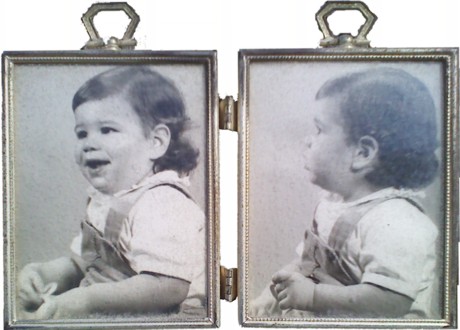
My mom’s favorite baby picture of me as about an 18-month old came before my first ever haircut. My folks, having grown up in the Depression and then gone through WWII, considered the crew cut the height of fashion. They subjected me to the weekly travail of itchy fur down the back of my shirt all the way through high school.

In early 1921 Mathew Andis, Sr. built the first electric hair clipper but the John Oster Manufacturing Company became the USA industry standard in 1928. I never knew a barber without that particular sheep shearing implement.

I rebelled in senior high. It was the era of the Mop Top Beatles so I grew my crew cut out into a … flat top!

“A flattop is a type of very short hairstyle similar to the crew cut,” Wikipedia reports “with the exception that the hair on the top of the head is deliberately styled to stand up (typically no more than an inch) and is cut to be flat, resulting in a haircut that is square in shape. It is most often worn by men and boys, particularly those in the military and law enforcement in the United States.

“The haircut is usually done with electric clippers to cut the side and back hair to or near the scalp, and then more intricate cutting is done on the top hair to achieve a level plane. When cutting a new flattop, the top hair is usually cut to about an inch long, then blow-dried to stand up straight, and then finally cut with clippers and scissors to achieve the final look. Wax can be used to stiffen the front of the flattop.”

The real issue with a flat top is that it leaves a nearly bald strip right down the center of that aircraft carrier landing deck on the very top of one’s head. Some few flat top fanciers worry about drones landing there but that rarely happens here in the States.

Hair Today ...I shaved my head for the Cap Cancer fund raiser and kept it shaved until about November of that year. It gets cold in Vermont about September. I let my hair grow out a little for insulation and discovered I had enough to square it off. Woo hoo!

A real flat top, baby! No butch wax, though.

I don’t exactly want to fess up to thinning hair but I am 62 now and the hair atop my head is still fine but no longer black. In fact, my beard is white and most of the hair above it is steel gray. About the same color as the navy paints its carriers. Unfortunately, the hair at my very crown is finer and whiter than anywhere else. It is very hard to see. Especially when it’s just 1/8″ long.

My granddaughter says it looks like I’m bald down the middle with a row of fence posts down the sides.

Kids have no sense of history.

Reduce, Reuse, Recycle, Toss

No plastic garbage bag will open from the end you first try.
— Internet wisdom

Good to know.

I’ve never had that problem since I use plastic grocery bags in all the garbage cans.

Back in the dark ages, a grocery store bag boy carefully placed all your perishables in one proud paper bag and your canned goods in a double bag and your sundries in a third paper bag. The bags themselves were designed with folds to make them stack easily and flat bottoms to make them simple to fill. My mom could usually get a couple more uses out of a bag — carting books to the library or supplies down to the boat — before using it to line the trash can. And a paper bag full of trash could be burned easily or composted or left to rot away in days at the dump.

When the grocery chains stopped asking “paper or plastic,” I had to substitute a plastic bag for the paper bag in the trash can.

Now the Far Green wants us to stop using plastic grocery bags because they clog the landfills. Grocers are happy to go along because the grocery bags cost them money and because we now have to buy something to handle our trash.

Common sales wisdom is that the most effective marketing campaign ever was the addition of a single word to a label. The story isn’t true (a marketing executive becomes an industry legend by adding the word REPEAT to shampoo bottles in writer John Cheever’s son Benjamin’s novel The Plagiarist — shampoo sales doubled overnight) but that’s marketing.

I reckon the most effective marketing campaign ever was crafted when Canadians Harry Wasylyk, Larry Hansen, and Frank Plomp invented a product whose only purpose is to be thrown away.

Let’s examine that in light of our new, Far Green, sensibility.

“A bin bag, swag sack or bin liner or garbage bag or trash bag is a disposable bag used to contain rubbish or trash,” says Wikipedia. The only reason you buy a garbage bag is to throw it away.

Sheesh.

“Most commonly, the plastic used to make bin bags is the rather soft and flexible LDPE (Low Density Polyethylene) or, for strength, LLDPE (Linear Low Density Polyethylene) or HDPE (High Density Polyethylene) are sometimes used.

“Some bags are made of biodegradable polythene film. These will decompose when exposed to air, sun, and moisture or submitted for composting. They do not readily decompose in a sealed landfill. They are also considered a possible contaminant to plastic recycling operations.

That’s good news. Not.

“Kind of makes you wonder what else the environmentalists got wrong,” Rufus muttered.

Anne and I both reuse grocery bags to cart books to and from the library. I’ve reused them to protect my cellphone in the rain and to carry a dripping towel from the beach. Rufus stores spent coffee grounds (which he figured is redundant) to use later as mulch. And we have never, ever had trouble opening a grocery bag to refill it with either stuff or trash.

For the record, no plastic produce bag will open from the end you first try, either, despite the HUGE green arrow printed onnit.

“Wet your fingertips first,” Rufus said. “It works much better.”

That’s exactly correct, as long as you actually try the end with the HUGE green arrow.

Dear Unca Warren

Dear Warren:

I now know I will never be a billionaire.

See, I always thought that, in addition to luck, and drive, and knowledge, a prospective billionaire had to be smart.

I’m sometimes lucky. I’m a Type A so I have drive. I’m a pretty fair researcher so I have knowledge. Unfortunately, I’m pretty smart. I know this because my mom told me so. More important, all of my teachers told me the same thing (usually as part of the sentence, “Dammit, Dick, you’re too smart to have pulled that boneheaded stunt“).

Apparently, I’m also too smart to be a billionaire.

Speaking of boneheaded, I see that you haven’t figured out that we, you and I, already pay a higher income tax rate than your secretary does. See, we own the companies that pay us the dividends so we’ve paid up to 35% of that profit to your friend Barry right off the top.

Sort of an old-style Las Vegas skim.

Since your friend Barry claims many corporations pay zero taxes, let’s pretend that we own a real small business C corporation that really pays real rate of 17.5%, half the official rate for the companies he says pay nothing.

17.5%

Now your friend Barry wants to raise the dividend tax rate from the current 15% to 39.6%. Next, he has already planned the phase-out of deductions and exemptions; that raises the rate to 41%. Don’t forget to add the 3.8% investment tax surcharge in ObamaCare, and the dividend tax rate next year will be 44.8%.

But wait. There’s more!

Before we get there, I nearly forgot that you and I are almost old enough to be thinking about retirement. Did you know that about three of every four dividend payments go to those who are over 55? Heck, more than half go to the really old peeps. The ones who are older than 65.

We also forgot the 17.5%.

Forgetful we are.

Add the 17.5% corporate tax rate plus 44.8% dividend tax and the the total tax on our corporate earnings passed through as dividends will be … 62.3%.

Your friend Barry gets almost 5/8 of what we make; we get 3/8.

I think we need to jack up your secretary’s tax rate.

That’s the Buffett Rule, right? It’s only fair you know.

Your partner,
Dancing


P.S. Since I’m a smart feller, I figured the original Buffett Rule was “charge people fairly.” The way to do that, of course, is not to tax income that has already been taxed and then to make sure that everyone, rich and poor, pays the same tax rate.

By the way. I wrote the Flat Tax column when I was still in my 40s and you had just collected your first Social Security check. It was a smart policy then and still is today.

Anarchy

We need a little more anarchy. I’m late in posting this because I had to write it from a New York jail.

See, I made a serious error in judgement. I texted my friend Liz Arden from my car. “On my way to Plattsburg Airport,” I wrote.

I was about to pull back out onto entrance ramp from the shoulder where I had stopped when I noticed flashing lights in the rear view mirror.

“May I see your license and registration, sir?” the trooper asked politely.

“What’s the trouble, officer?” I said.

“You are in violation of section 1225-d of the vehicle and traffic law of New York state,” he replied. “Texting while operating a motor vehicle.”

“I wasn’t moving, officer. My speed was zero. I pulled over and stopped deliberately to sit here so I could use my electronic device safely and legally.”

“New York does not require you to be speeding for me to consider that you are operating your vehicle, sir.”

I found that interesting, since motion is defined as the act, process, or state of changing place or position and some ΔV is necessary to effect that.

Sir Isaac Newton compiled his laws of motion in the 17th Century, some years before we started regulating vehicular communication. In fact, some years before we started thinking about vehicles powered by much other than hay. His three laws describe the relationship between the forces acting on a body and its motion due to those forces; they form the basis for classical mechanics.

Newton’s First Law: The velocity of a body remains constant unless the body is acted upon by an external force. It is often expressed as “a body in motion stays in motion and a car sitting dead on the street ain’t moving.”

“Now wait just a darned minute,” I said. Troopers like being told that. “Imagine this scenario, officer. Imagine that I am sitting in a public park, motionless, with a butter knife. A ground squirrel has chewed on my nuts. I am seriously enraged and am plotting the hideous death of that squirrel. Foam is coming out of my ears. Steam from my mouth. But the squirrel is still sitting in the tree, chattering. And I haven’t moved from my park bench.”

He moved his hand to the side of his utility belt.

“Step out of the car, please, sir.”

“You can’t arrest me for murder for sitting in a public park, motionless, with a butter knife,” I told him. “So you also can’t arrest me for a moving violation when I am sitting in my stopped car, motionless.”

Or not.

Vermont’s 2009 “Texting Law” (23 V.S.A. § 1099) states, “A person shall not engage in texting while operating a moving motor vehicle on a highway.” New York’s law is similar but longer winded. Police in New York can stop drivers for using handheld devices while driving, making it a primary traffic offense. That state’s law also increased the penalty from a two- to a three-point offense with a fine of up to $150.

The trooper is using a definition of “operate a motor vehicle” that means more than just “drive,” “driving,” or “driven.” Their definition seems to cover all matters related to having a car near a highway, whether you be in actual motion or at rest.

Under those circumstances, the New York law that states that “no person shall operate a motor vehicle unless all front seat passengers under the age of sixteen are restrained by a safety belt…” means that the trooper can cite me for sitting at the foot of my friend’s driveway in Rouse’s Point with my granddaughter if she’s not belted in.

“I’m thinking it’s time to tune up the law,” my friend Denny Crane might say.

Fortunately, the cursory examination of my car didn’t turn up the butter knife in my glove box.