




Humans rely on habit and muscle memory to accomplish every day tasks.
Ergonomists know every detail about how we interact with our tools. Frederick Winslow Taylor who earned a degree in mechanical engineering by correspondence at Stevens Institute of Technology, pioneered the “Scientific Management” method to find the optimum method for carrying out pretty much any job. During WWII, a young lieutenant named Alphonse Chapanis eliminated most “pilot error” by de-confusing airplane controls.
In about 1973, a fellow on my pit crew installed the shift linkage backwards on the race car. I went out and shifted from third gear to first when I thought I was grabbing fourth. Surprised pretty much everyone including the engine builder when that about stood the car on its nose.
“A good driver should be able to adjust,” he said.
No. A good driver should be able to concentrate on pointing the car, not on where the next gear might be this week.
Big consumer companies employ most of the (working) ergonomists in the universe. Heck, I’d bet a doughnut that two or three of them work for Microsoft. Why are these consumer companies so blind to the way we accomplish everyday tasks? Why do they want us to keep adjusting to different shift linkages?
Liz Arden mentioned this morning that Google has changed its Latitudinal Check In so she can’t just poke a button on her desktop any more.
Not a biggie in the grand scheme of things but it fits the age old question, why did they have to fix something that weren’t broke?
Google had trained us to use their service one way and now they want us to do it some other way for no reason other than that they can.
Adrian Kingsley-Hughes wrote three years ago that Windows 7’s changes “suggest … that Microsoft is putting design ahead of usability.” Ya think? Apple afficionados say the same thing about the company Mr. Jobs built on the perfect User Interface. I Googled “Lion annoyances” and came up with about 297,000 results which is far fewer than the 1,540,000 results I found for “Windows 7 annoyances.” An entire industry has had to spring up to publish quick cures and workarounds for the two most “popular” computer operating systems.
Lion changed the three finger salute of Snow Leopard to two fingers, and reserved the three finger gesture for Mission Control. In Windows 7, you can’t tell which programs are actually running on the Taskbar and which are just links since some, like Internet Exploder, add an identical button for every open window and some, like WordPerfect and Dreamweaver, simply change the look of the one button so you know what to push. Microsoft also moved all the files around in Windows 7 so “My Documents” is now just another broken link and your IT department can’t find anything without retraining.
Microsoft and Apple had trained us to use our computers one way and now they want us to do it some other way for no reason other than that they can.
And who ever heard of pushing “START” to turn off the engine.
Oh. That’s how keyless cars work now, too.
Every time I thought I’d got it made
It seemed the taste was not so sweet
NPR jumped on that bandwagon last week when Science Friday changed its website. “Redesigned with you in mind” is its new banner.
You maybe, but not me. It is now totally buggered.
I don’t subscribe to many podcasts because I don’t necessarily listen to every show and have enough clutter on both my hard drive and my broadband connection to want it filled with stuff I don’t use. SciFri trained me to go to their site to download the segments I want to hear each week. It was fast. It was accurate. It was scientific.
SciFri had trained us to listen one way and now they want us to do it some other way for no reason other than that they can.
Like host Ira Flatow’s approach to Global Warming, the site is no longer fast, nor accurate, nor scientific. In fact, of the two segments I grabbed last week, one had pieces of three with one piece repeated and the other was screwy. [ed. note: see the update from NPR in the Comments section below.]
Airheads.
I can fix this by teaching the companies just one word but I dont work cheap.

Everyone who is anyone must already own a DROID RAZR. Otherwise Verizon Wireless wouldn’t have to market the phone to Id10Ts like this mother and daughter:
In Diane Keaton: Here I Am in AARP Magazine, writer David Hochman writes that Keaton “acknowledges how challenging it is to juggle a still-busy career with a teen and a preteen at an age most women are feathering their empty nests with IKEA guest beds.”
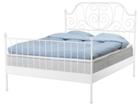 That annoyed a midwestern friend who responded, “But then I remembered: last year I bought one. For myself, true, but still…”
I had to go look up what an IKEA bed was.
My grandfather bought new beds for the Keys house but I have never bought a bed. Other than those, I think the newest bed in my inventory was bought in 1886.
“I sure hope you’ve bought mattresses for those old beds, Dick.”
Mattresses?
Horsehair lasts forever.
(I do tighten the ropes every now and then, though.)
The truth about mattresses.
I come from an old Quaker family that never threw anything away. I can about count on my fingers all the furniture I’ve bought in my life: an oak drawing table, a walnut sideboard, the double recliner, the dining room chairs we gave to our daughter, a bedside table, a hassock. Porch furniture doesn’t count. Nor do the beds I built in New Jersey or the shower seat and the built-ins in Vermont. Anne and I have never been able to agree on a sofa so we don’t have one.
My great-grandfather Enos Barnard was a very short man, so he had a full size low-post bed cut down — it is about 64 inches nose to tail. I slept in that bed as a six-foot teenager which is why I still sleep diagonally even in a California King. And my uncle convalesced in that bed when he returned from the War. He is 6’5″ tall. His feet hung over the end which is the actual etymology of that phrase.
In North Puffin I sleep in the same maple Sheraton “4-poster” bed with a flat tester frame that my parents did. That and all the other beds will just about fit a full size (54″ x 75″) mattress with only a wee little bit of slightly droopy overhang. Don’t sleep on the very edge. My guest room beds are the same size — my mother’s mother’s bed from uphome and the guest room bed from downhome. Someone Before Me removed their rope knobs.
The attic there has the three beds we aren’t using plus their mattresses and boxes. I think the newest bed, the 1886 iron frame I slept in after I outgrew my great-grandfather’s bed is also there but my cousin Terry may have it.
Box springs are more difficult with older beds that don’t fit today’s twin/full/queen/king/Cali king standards. The frame rails on my full beds are set too close together to accommodate a ready-made box so the choice is to custom make the box spring that will sit between the rails or use a sky hook to get into a bed with the frame 33″ off the floor, plus the box spring and the 14″ of poof-top modern mattress. That would be taller than the mattress is wide. It’s a good thing we have high ceilings, but I would knock that tester off with an errant elbow.